
Thank you for Subscribing to Food Business Review Weekly Brief


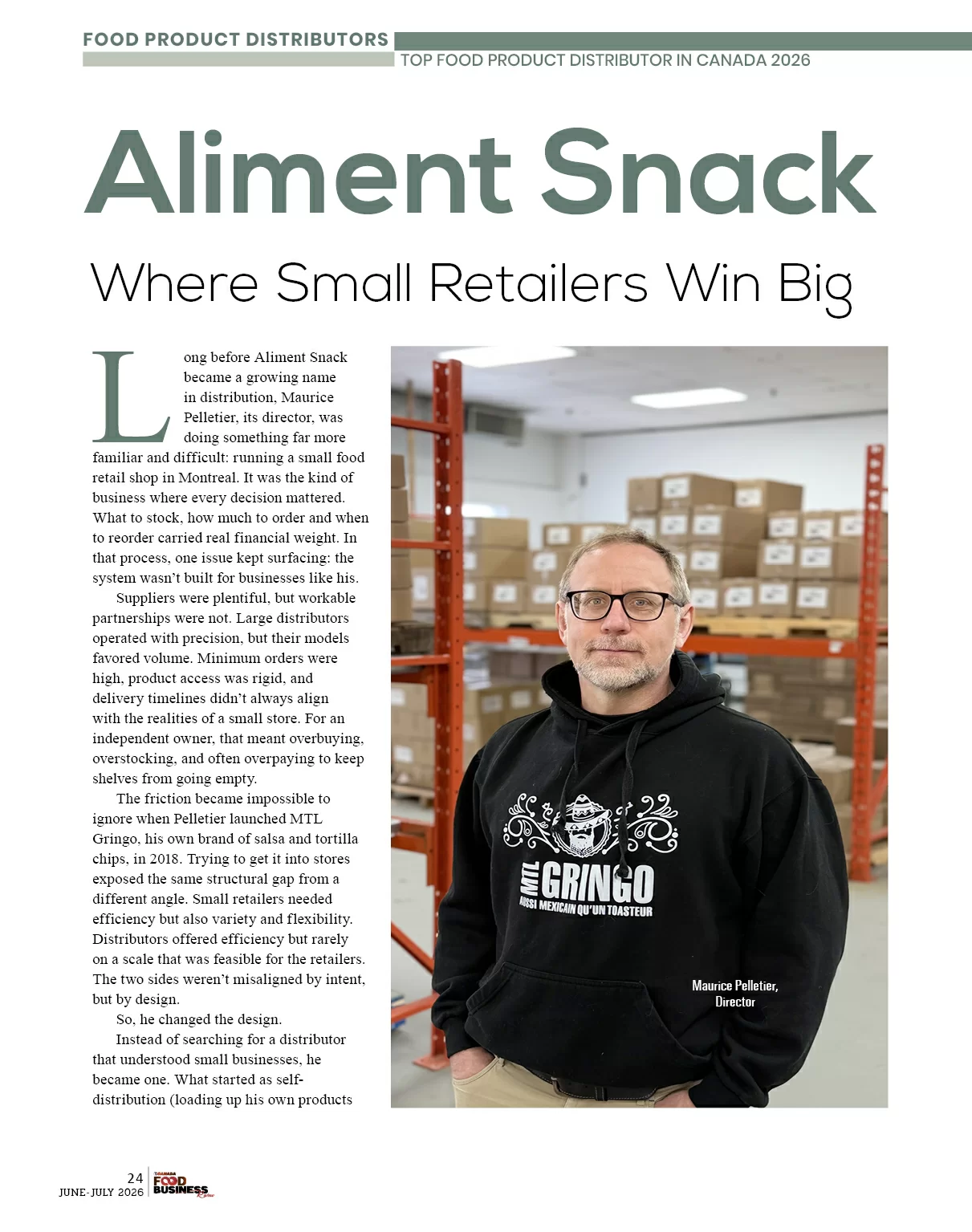
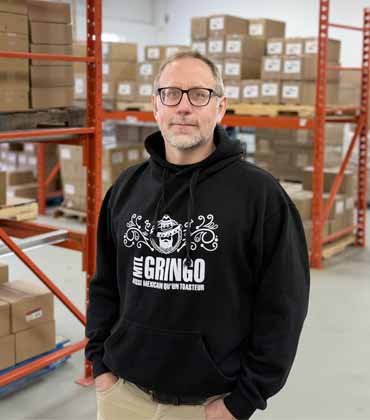 Maurice Pelletier, Director
What challenges do small independent retailers face within traditional food distribution systems?
Long before Aliment Snack became a growing name in distribution, Maurice Pelletier, its director, was doing something far more familiar and difficult: running a small food retail shop in Montreal. It was the kind of business where every decision mattered. What to stock, how much to order and when to reorder carried real financial weight. In that process, one issue kept surfacing: the system wasn’t built for businesses like his.
Suppliers were plentiful, but workable partnerships were not. Large distributors operated with precision, but their models favored volume. Minimum orders were high, product access was rigid, and delivery timelines didn’t always align with the realities of a small store. For an independent owner, that meant overbuying, overstocking, and often overpaying to keep shelves from going empty.
How did Maurice Pelletier identify structural gaps affecting independent retailers and distributors?
The friction became impossible to ignore when Pelletier launched MTL Gringo, his own brand of salsa and tortilla chips, in 2018. Trying to get it into stores exposed the same structural gap from a different angle. Small retailers needed efficiency but also variety and flexibility. Distributors offered efficiency but rarely on a scale that was feasible for the retailers. The two sides weren’t misaligned by intent, but by design. So, he changed the design.
Instead of searching for a distributor that understood small businesses, he became one. What started as self-distribution (loading up his own products and delivering them across Quebec), quickly evolved into something larger. On each route, Pelletier began adding complementary items: candies, chips, preserves. The logic was simple but powerful. If small stores needed one reliable delivery, it might as well carry everything they struggled to source elsewhere. That insight became the foundation of Aliment Snack, a distribution system built for small independent stores.
Rather than building a system around volume, the company was built around the very constraints most distributors overlooked. Smaller minimum orders meant retailers could stock shelves without tying up capital. A broad but curated product mix allowed them to experiment without committing to bulk quantities. And online ordering from one company saved valuable time by avoiding the need to communicate directly with each individual producer. By managing its own distribution, Aliment Snack ensured that efficiency and reliability, which were often taken for granted at scale, became a guarantee for smaller clients as well.
“We bring the operational efficiency of large distributors while staying aligned with the scale, flexibility, and everyday realities of small independent stores,” Pelletier explains. It’s a simple statement, but one that captures a balancing act of combining operational discipline with real-world flexibility.
-
We bring the operational efficiency of large distributors while staying aligned with the scale, flexibility, and everyday realities of small independent stores.
Why does inventory flexibility matter for newly established independent retail stores today?
The impact is most visible at the earliest stages of a store’s life. New retailers, often working with limited space and uncertain demand, can build out their shelves gradually. They can test across categories, adjusting, refining, and scaling as customer preferences become clear instead of betting heavily on a narrow set of products. It transforms inventory from a fixed burden into something far more dynamic.

In what way does responsive customer service strengthen continuity for independent retail operations?
Responsive and efficient customer service sits at the core of what differentiates Aliment Snack from larger distributors. The dedicated bilingual team understands that even a minor disruption in delivery can create immediate pressure for a small retailer, where inventory gaps translate directly into lost sales. Close familiarity with both clients and products enables quick decisions and fast resolutions to help stores maintain continuity without unnecessary risk.
As the model proved itself, growth followed. What began with a single product line expanded into hundreds of items sourced almost entirely from Canadian brands. A dedicated warehouse, recently upgraded to support increasing demand, now anchors operations. While the company’s roots remain firmly in Quebec, interest from retailers in other provinces has opened the door to expansion, driven less by ambition than by pull.

Yet, for all its growth, Aliment Snack hasn’t drifted from its original premise. “We still focus on small independent stores and that’s what guides every decision we make,” says Pelletier. The same challenges that shaped the business at its inception continue to define its direction. That balance between growth and proximity has earned Aliment Snack the distinction of Top Food Product Distributor.
In a distribution landscape optimized for scale, Aliment Snack is built on proximity to the problem. Not observed from a distance, but lived firsthand. In solving for that experience, it has done more than move products and created a system where smaller businesses can operate with a level of confidence once reserved for much larger players.
Selecting a Distribution Partner For Independent Food Retail Success in Canada
Food retail executives across Canada face a persistent imbalance in distribution access. Large chains benefit from scale-driven supply systems, predictable delivery cycles and favorable procurement terms, while independent stores operate under tighter constraints tied to inventory risk, cash flow sensitivity and limited storage capacity. This divide often leaves smaller retailers underserved, forcing them to compromise between product variety and financial discipline. The result is not simply a sourcing issue but a structural challenge that shapes how independent businesses grow, test new offerings and maintain shelf consistency.
A distributor suited to this environment must balance reliability with flexibility. Consistent delivery timelines remain essential, yet rigid order structures can quickly erode value for smaller operators. Many distributors maintain high minimum thresholds or prioritize volume efficiency, which works against stores that need to experiment with product mix or manage uncertain demand. The ability to supply without frequent backorders, while maintaining manageable order sizes, becomes a defining factor in sustaining shelf availability without overextending working capital.
Product differentiation also plays a critical role. Independent retailers rely on assortment as a competitive lever, often seeking items that are not widely available across major chains. Access to a curated mix of snacks, pantry goods and beverages allows these stores to establish identity and attract repeat customers. A distributor that can provide variety without overwhelming inventory requirements enables retailers to refine their selection gradually, aligning stock with customer preferences rather than committing upfront to large quantities.
Service quality further shapes long-term viability. Smaller stores often require closer interaction, quicker response times and a level of adaptability that larger systems do not prioritize. A distribution partner must align its processes with the pace and scale of independent retail operations, ensuring that ordering, delivery and support remain accessible rather than transactional. This alignment determines whether a distributor functions merely as a supplier or as an enabler of steady growth.
Within this context, Aliment Snack presents a model that directly addresses these pressures. Originating from firsthand experience as a small retailer, it has structured its distribution approach around the constraints independent stores encounter daily. It supplies a wide range of shelf-stable products, primarily snacks, alongside complementary pantry items and beverages, offering variety without imposing excessive volume commitments. Its network emphasizes Canadian products while incorporating select international items, allowing retailers to differentiate their shelves without sacrificing familiarity.
The company’s defining strength lies in combining the efficiency typically associated with large distributors with conditions suited to smaller businesses. It maintains lower minimum order requirements, enabling new or growing stores to stock shelves without tying up capital in surplus inventory. Delivery practices are designed to remain predictable and responsive, reducing the risk of stock gaps while supporting gradual order scaling as stores expand. This approach has proven particularly valuable for newly established retailers that need to test product performance before committing to higher volumes.
Aliment Snack’s continued expansion beyond Quebec, supported by increased warehouse capacity and a growing product portfolio, indicates an ability to scale while maintaining its focus on independent stores. Its distribution model does not attempt to replicate large-chain systems; instead, it adapts those efficiencies to fit smaller retail realities. For executives evaluating food product distribution partners in Canada, it represents a practical and well-aligned choice where flexibility, reliability and curated assortment must coexist.
...Read more
Food Product Distributors Info
Q1
What Should Independent Retailers Expect from Food Product Distributors in Canada?
Most independent retailers are not trying to fill a warehouse. They are trying to keep shelves interesting without locking too much cash into inventory that may not move. That is why smaller stores usually look for food product distributors in Canada that allow lower order volumes and give them room to test new snacks, drinks and pantry products without taking unnecessary risk. Aliment Snack built its model around that reality, giving retailers access to a curated mix of products through one ordering system instead of forcing them to manage multiple suppliers for small quantities.
Q2
How Does Aliment Snack Help Small Stores Manage Product Variety?
For smaller retailers, product sourcing can easily turn into a full-time headache. One supplier handles chips, another handles candy and someone else handles specialty products, all with separate minimums and delivery schedules. Aliment Snack grew out of Maurice Pelletier’s own retail experience in Montreal and later the self-distribution of MTL Gringo salsa and tortilla chips. That background shaped a simpler approach where stores can bring in candies, chips, preserves and related products through one route instead of juggling several small accounts every week.
Q3
Why Does Inventory Flexibility Matter in Food Distribution?
Most new or growing stores do not know exactly which products customers will keep coming back for. A shelf that looks good on opening week may need a completely different mix a month later. Food product distributors in Canada become more useful when they let retailers adjust gradually instead of overbuying too early. Smaller orders and a broader assortment give store owners space to figure out what actually sells instead of relying on guesswork. It also helps avoid stacks of slow-moving inventory sitting in limited backroom storage.
Q4
What Service Factors Matter Beyond Product Access?
Getting products into a store is only part of the job. Retailers also need quick answers when deliveries shift, orders change or shelves suddenly empty faster than expected. Food product distributors in Canada tend to stand out when their teams understand how stressful small retail operations can become during busy weeks. Aliment Snack supports retailers with a bilingual service team that can respond quickly and keep orders moving. For smaller stores, a missed delivery is not a minor inconvenience. It can directly affect daily sales.
Q5
How Should Retailers Evaluate a Distribution Partner?
A distributor usually reveals more during a normal reorder than during a sales pitch. Retailers should pay attention to minimum order requirements, delivery consistency, substitute products and how clearly pricing changes are communicated. Food product distributors in Canada should make replenishment easier, not create more operational work for already busy store owners. One of the simplest ways to evaluate a partner is to place a mixed order, request a quick reorder on a fast-selling item and see how the distributor responds when stock availability changes unexpectedly.
Q6
What Signals That a Distributor Can Grow Without Losing Focus?
Growth matters, but smaller retailers usually care more about whether service quality changes once a distributor expands. Aliment Snack has grown from a single product line into a broader portfolio made up mostly of Canadian brands while also upgrading its warehouse operations to support higher demand. For food product distributors in Canada, expansion only works when smaller stores still get flexible ordering, dependable deliveries and manageable inventory risk instead of being pushed aside for larger accounts.
Company :
Aliment Snack
Management Maurice Pelletier, Director
Description
Aliment Snack is an independent food distributor serving small retailers, delis, and restaurants with a curated range of shelf stable products. It delivers reliable supply, low minimum orders, and unique local products, helping independent businesses stock efficiently and grow without the constraints of traditional distribution systems.