
Thank you for Subscribing to Food Business Review Weekly Brief


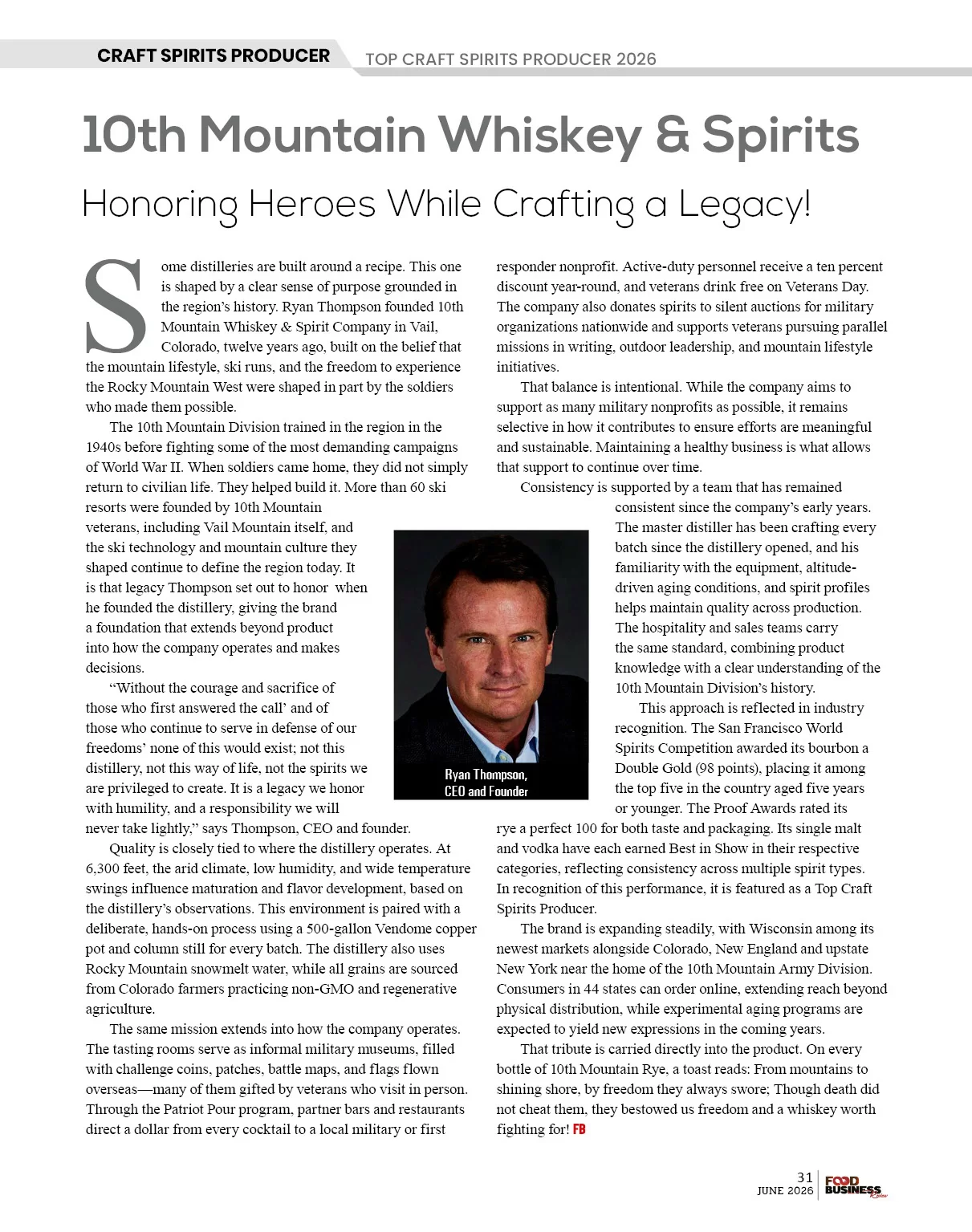
 Ryan Thompson, CEO and Founder
What historical legacy shapes the foundation and purpose of 10th Mountain Whiskey & Spirits?
Some distilleries are built around a recipe. This one is shaped by a clear sense of purpose grounded in the region’s history. Ryan Thompson founded 10th Mountain Whiskey & Spirit Company in Vail, Colorado, twelve years ago, built on the belief that the mountain lifestyle, ski runs, and the freedom to experience the Rocky Mountain West were shaped in part by the soldiers who made them possible.
The 10th Mountain Division trained in the region in the 1940s before fighting some of the most demanding campaigns of World War II. When soldiers came home, they did not simply return to civilian life. They helped build it. More than 60 ski resorts were founded by 10th Mountain veterans, including Vail Mountain itself, and the ski technology and mountain culture they shaped continue to define the region today. It is that legacy Thompson set out to honor when he founded the distillery, giving the brand a foundation that extends beyond product into how the company operates and makes decisions.
“Without the courage and sacrifice of those who first answered the call’ and of those who continue to serve in defense of our freedoms’ none of this would exist; not this distillery, not this way of life, not the spirits we are privileged to create. It is a legacy we honor with humility, and a responsibility we will never take lightly,” says Thompson, CEO and founder.
How do environmental factors and production methods influence the distillery’s product quality and consistency?
Quality is closely tied to where the distillery operates. At 6,300 feet, the arid climate, low humidity, and wide temperature swings influence maturation and flavor development, based on the distillery’s observations. This environment is paired with a deliberate, hands-on process using a 500-gallon Vendome copper pot and column still for every batch. The distillery also uses Rocky Mountain snowmelt water, while all grains are sourced from Colorado farmers practicing non-GMO and regenerative agriculture.
Why does the company integrate military support initiatives into its operational and community engagement model?
The same mission extends into how the company operates. The tasting rooms serve as informal military museums, filled with challenge coins, patches, battle maps, and flags flown overseas—many of them gifted by veterans who visit in person. Through the Patriot Pour program, partner bars and restaurants direct a dollar from every cocktail to a local military or first responder nonprofit. Active-duty personnel receive a ten percent discount year-round, and veterans drink free on Veterans Day. The company also donates spirits to silent auctions for military organizations nationwide and supports veterans pursuing parallel missions in writing, outdoor leadership, and mountain lifestyle initiatives.
-
Without the courage and sacrifice of those who first answered the call’ and of those who continue to serve in defense of our freedoms’ none of this would exist; not this distillery, not this way of life, not the spirits we are privileged to create. It is a legacy we honor with humility, and a responsibility we will never take lightly.
That balance is intentional. While the company aims to support as many military nonprofits as possible, it remains selective in how it contributes to ensure efforts are meaningful and sustainable. Maintaining a healthy business is what allows that support to continue over time.
In what way do team experience and recognition contribute to brand growth and market expansion?
Consistency is supported by a team that has remained consistent since the company’s early years. The master distiller has been crafting every batch since the distillery opened, and his familiarity with the equipment, altitude-driven aging conditions, and spirit profiles helps maintain quality across production. The hospitality and sales teams carry the same standard, combining product knowledge with a clear understanding of the 10th Mountain Division’s history.
This approach is reflected in industry recognition. The San Francisco World Spirits Competition awarded its Bourbon a Double Gold (98 points), placing it among the top five in the country aged five years or younger. The Proof Awards rated its rye a perfect 100 for both taste and packaging. Its single malt and vodka have each earned Best in Show in their respective categories, reflecting consistency across multiple spirit types. In recognition of this performance, it is featured as a Top Craft Spirits Producer.
The brand is expanding steadily, with Wisconsin among its newest markets alongside Colorado, New England and upstate New York near the home of the 10th Mountain Army Division. Consumers in 44 states can order online, extending reach beyond physical distribution, while experimental aging programs are expected to yield new expressions in the coming years.
That tribute is carried directly into the product. On every bottle of 10th Mountain Rye, a toast reads: From mountains to shining shore, by freedom they always swore; Though death did not cheat them, they bestowed us freedom and a whiskey worth fighting for!
Evaluating Craft Spirits Producers for Distinctive Quality and Market Differentiation
For executives sourcing premium spirits, the challenge no longer lies in finding capable producers but in identifying those that can sustain differentiation in a crowded craft landscape. The proliferation of small-batch distilleries has elevated baseline expectations around quality, forcing buyers to look beyond surface-level branding and into the underlying mechanics that shape consistency, provenance and long-term value in a portfolio.
Product distinction begins with how a producer defines and controls its production environment. In craft spirits, subtle variables such as altitude, temperature variation and humidity exert measurable influence on maturation and flavor development. Producers that understand and leverage these environmental conditions tend to deliver spirits with more defined profiles and predictable aging outcomes. Buyers evaluating long-term supply relationships often prioritize those that can articulate how their production context directly enhances the final product rather than treating it as incidental geography.
Equally important is the degree of control exercised during distillation. Hands-on production, supported by experienced distillers who remain closely involved in each batch, tends to yield more consistent results than heavily automated processes. This is not a rejection of efficiency but a recognition that flavor calibration in premium spirits still depends on human judgment. Producers that maintain continuity in their distilling leadership and demonstrate deep familiarity with their equipment often achieve a level of refinement that is difficult to replicate at scale.
Ingredient sourcing introduces another layer of differentiation that extends beyond marketing narratives. Local sourcing, when executed with discipline, can improve both quality and supply reliability while reinforcing sustainability considerations that increasingly influence buyer decisions. Partnerships with regional farmers, particularly those aligned with regenerative practices, can translate into more consistent raw materials and a clearer provenance story for end consumers. Buyers benefit from producers that integrate sourcing decisions into product integrity rather than treating them as an external supply function.
Recognition from independent competitions continues to serve as a useful external validation signal, though it carries weight only when supported by consistent performance across multiple categories. Awards that span different spirit types and judging bodies suggest a producer’s ability to maintain quality across its portfolio, not just within a single flagship product. Buyers often interpret this breadth of recognition as an indicator of disciplined production processes and repeatable outcomes.
The experiential dimension also plays a role in how spirits perform in market environments. Producers that create a coherent brand narrative, supported by authentic engagement with customers and trade partners, tend to build stronger downstream demand. Programs that enable on-premise partners to integrate the brand into their own customer experience, while contributing to local community initiatives, can strengthen both visibility and loyalty without relying on aggressive promotional tactics.
Within this landscape, 10th Mountain Whiskey & Spirits presents a compelling case as a producer that aligns production discipline with a distinct identity and measurable quality outcomes. Its approach combines hands-on distillation using a copper still system with maturation at high altitude, where low humidity and temperature variation accelerate maturation and influence flavor development. It reinforces this foundation through the use of locally sourced Colorado grains and Rocky Mountain snowmelt water, supporting product integrity and regional sourcing. Independent recognition across bourbon, rye, vodka, and single malt categories signals breadth in execution, while partnership programs with hospitality venues—linking product use to community contributions—add an additional layer of engagement. For buyers prioritizing quality, provenance, and sustained differentiation, it represents a considered choice within the craft spirits segment.Top of Form
...Read more
Craft Spirits Producers Info
Q1
What Should Buyers Look for in Craft Spirits Producers?
Craft Spirits Producers should help buyers understand what is actually shaping the spirit inside the bottle. Things like grain source, distillation method and barrel aging usually matter more than the label story around them. Buyers also tend to look for consistency from batch to batch because a good whiskey or vodka should still feel familiar the next time someone orders it. In practice, people compare spirits through flavor, proof, aging style and finish, not just branding.
Q2
How Does 10th Mountain Whiskey & Spirits Approach Craft Production?
10th Mountain Whiskey & Spirits keeps its production closely tied to Vail, Colorado and the history of the 10th Mountain Division while producing in small batches. The distillery uses Colorado grains, Rocky Mountain snowmelt water and a 500-gallon Vendome copper pot and column still. Those details affect how the spirits develop over time and help explain the flavor profile beyond tasting notes alone. The company’s mountain and military identity also stays closely connected to the product experience instead of feeling separated from it.
Q3
What Role Does Altitude Play in Flavor Development?
Altitude changes the way spirits mature in barrels. Dry air, lower humidity and temperature swings all affect how the liquid interacts with the wood during aging. 10th Mountain Whiskey & Spirits operates above 6,300 feet in the Colorado Rockies and links those local conditions to flavor development. That gives buyers a more practical explanation for character and finish than broad descriptions alone. It also helps explain why the aging process may feel different from spirits produced in other environments.
Q4
Why Do Ingredient Sources Matter in Small-Batch Distilling?
Ingredient sourcing affects flavor, consistency and even how reliable production stays over time. Grain quality, water source and supplier relationships all influence the final bottle, especially in smaller runs. Craft Spirits Producers that openly discuss sourcing usually make it easier for buyers to understand where the flavor profile comes from. Local sourcing can also strengthen regional identity when a distillery produces several types of spirits instead of relying on one flagship bottle.
Q5
How Can Brand Story Support Product Trust?
A brand story usually feels more credible when it connects back to the actual experience around the product. The featured distillery carries its military heritage into tasting rooms through challenge coins, maps, patches and flags, while its Patriot Pour program donates a dollar from participating cocktails to military and first responder nonprofits. That continuity helps the identity feel connected to the business itself instead of existing only in advertising. It also gives bars and restaurants something more meaningful to share with guests.
Q6
Which Quality Signals Help Differentiate Premium Spirits?
Awards, consistency and portfolio range can all help buyers evaluate premium spirits. The profile notes that the distillery’s bourbon earned Double Gold with 98 points at the San Francisco World Spirits Competition, while its rye, single malt and vodka also received recognition. Strong results across several spirit categories usually suggest more consistent production standards over time. Buyers can weigh those signals alongside aging style, batch method and overall product range before deciding what earns shelf or menu space.
Company :
10th Mountain Whiskey & Spirits
Management Ryan Thompson, CEO and Founder
Description
10th Mountain Whiskey & Spirits is a Colorado-based craft distillery inspired by the 10th Mountain Division. Operating at 6,300 feet in Vail Valley, it produces award-winning whiskey, vodka, and brandy using Colorado-grown grains, Rocky Mountain snowmelt, and hands-on distillation, with high-altitude conditions enhancing maturation and flavor depth.