
Thank you for Subscribing to Food Business Review Weekly Brief


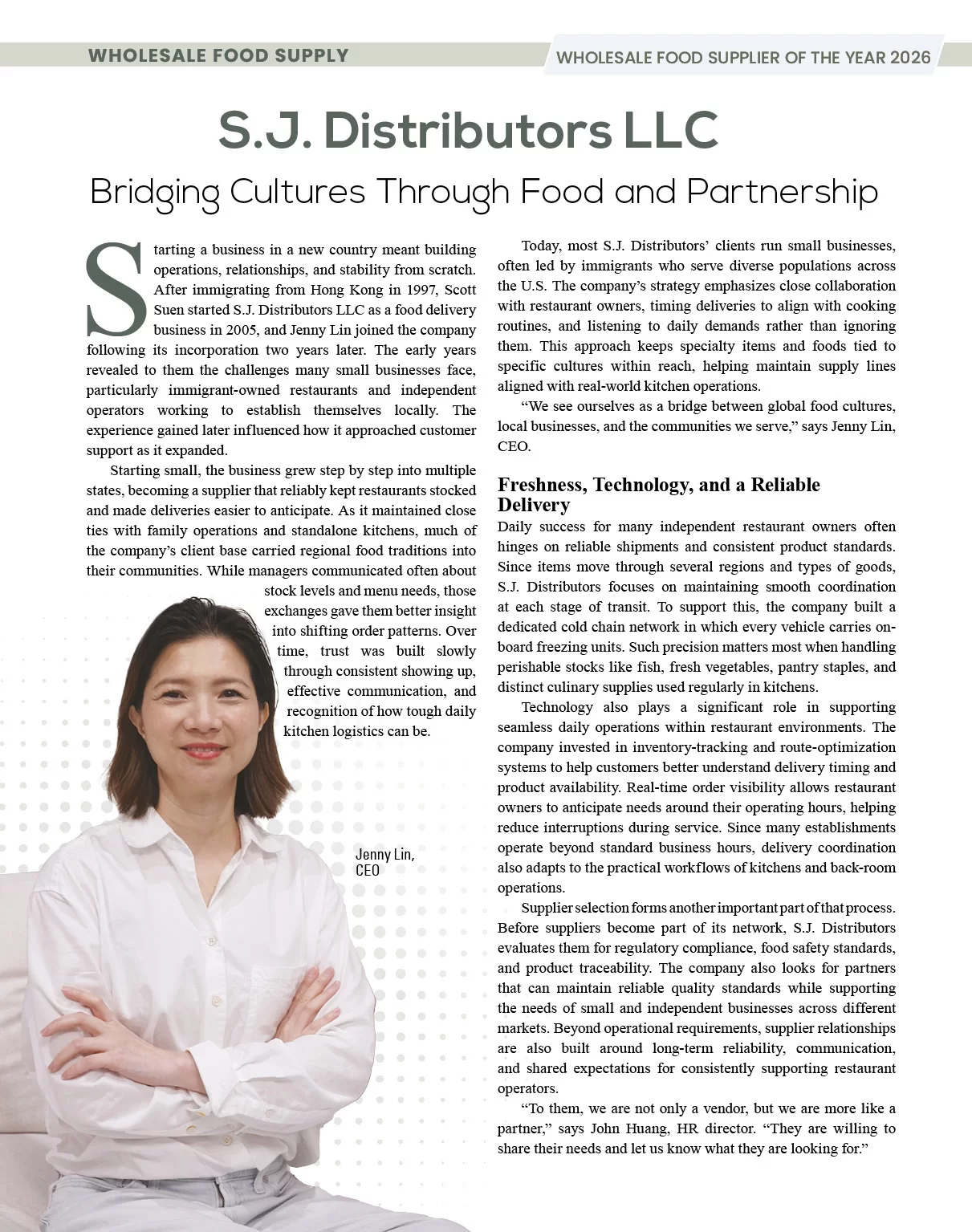
 Jenny Lin, CEO and John Huang, HR Director
Starting a business in a new country meant building operations, relationships, and stability from scratch. After immigrating from Hong Kong in 1997, Scott Suen started S.J. Distributors LLC as a food delivery business in 2005, and Jenny Lin joined the company following its incorporation two years later. The early years revealed to them the challenges many small businesses face, particularly immigrant-owned restaurants and independent operators working to establish themselves locally. The experience gained later influenced how it approached customer support as it expanded.
Starting small, the business grew step by step into multiple states, becoming a supplier that reliably kept restaurants stocked and made deliveries easier to anticipate. As it maintained close ties with family operations and standalone kitchens, much of the company’s client base carried regional food traditions into their communities. While managers communicated often about stock levels and menu needs, those exchanges gave them better insight into shifting order patterns. Over time, trust was built slowly through consistent showing up, effective communication, and recognition of how tough daily kitchen logistics can be.
Today, most S.J. Distributors' clients run small businesses, often led by immigrants who serve diverse populations across the U.S. The company’s strategy emphasizes close collaboration with restaurant owners, timing deliveries to align with cooking routines, and listening to daily demands rather than ignoring them. This approach keeps specialty items and foods tied to specific cultures within reach, helping maintain supply lines aligned with real-world kitchen operations.
“We see ourselves as a bridge between global food cultures, local businesses, and the communities we serve,” says Jenny Lin, CEO.
Freshness, Technology, and a Reliable Delivery
Daily success for many independent restaurant owners often hinges on reliable shipments and consistent product standards. Since items move through several regions and types of goods, S.J. Distributors focuses on maintaining smooth coordination at each stage of transit. To support this, the company built a dedicated cold chain network in which every vehicle carries on-board freezing units. Such precision matters most when handling perishable stocks like fish, fresh vegetables, pantry staples, and distinct culinary supplies used regularly in kitchens.
Technology also plays a significant role in supporting seamless daily operations within restaurant environments. The company invested in inventory-tracking and route-optimization systems to help customers better understand delivery timing and product availability. Real-time order visibility allows restaurant owners to anticipate needs around their operating hours, helping reduce interruptions during service. Since many establishments operate beyond standard business hours, delivery coordination also adapts to the practical workflows of kitchens and back-room operations.
Supplier selection forms another important part of that process. Before suppliers become part of its network, S.J. Distributors evaluates them for regulatory compliance, food safety standards, and product traceability. The company also looks for partners that can maintain reliable quality standards while supporting the needs of small and independent businesses across different markets. Beyond operational requirements, supplier relationships are also built around long-term reliability, communication, and shared expectations for consistently supporting restaurant operators.
“To them, we are not only a vendor, but we are more like a partner,” says John Huang, HR Director. “They are willing to share their needs and let us know what they are looking for.”
That level of interaction allows S.J. Distributors to anticipate customer demand better, prepare inventory more effectively, and respond more quickly to changing restaurant needs across the markets it serves. The company adapts to the practical realities restaurant owners face every day through its operational approach and continued focus on restaurant support. These efforts also contributed to its recognition as Wholesale Food Supplier of the Year 2026.
Providing Operational Impact and Inclusive Communication
Growth has never been measured simply by the number of markets the company enters; instead, it means helping more restaurants operate successfully while maintaining the same level of service and support customers depend on. As the business expanded into additional regions, maintaining close communication with restaurant owners remained an important part of supporting day-to-day operations across different communities.
Communication at S.J. Distributors extends beyond delivery routes or product availability. By supporting conversations in customers’ preferred languages, the company helps reduce misunderstandings during orders, scheduling, and follow-ups. Many restaurant owners come from different cultural and linguistic backgrounds, so clearer communication often helps daily operations run more smoothly during busy service hours and changing supply conditions. Digital translation tools also support communication when needed, particularly during menu changes or product adjustments. These efforts reflect the day-to-day realities of the communities it serves, where trust is often built through consistent communication, responsiveness, and long-term working relationships.
The Philosophy of Investing in Community
S.J. Distributors’ role extends beyond food distribution. Alongside supporting restaurants and small businesses, the company has continued to contribute to local communities through long-standing food bank partnerships at nearly all of its operating locations. Monthly donations have remained part of that effort for many years, reflecting the belief that businesses growing within communities should also contribute back to them.
-
We see ourselves as a bridge between global food cultures, local businesses, and the communities we serve.
Beyond direct donations, S.J. Distributors also views the support of independent restaurants as part of that broader impact, helping local businesses continue serving diverse neighborhoods with accessible and culturally familiar food products.
“While we continue to grow, we always remember the communities that supported us along the way,” says Lin, CEO. “That is why supporting local businesses and giving back has remained important to our company.”
As the company continues expanding into new markets, it remains focused on the restaurants and small businesses S.J. Distributors has grown alongside over the years. Many of those establishments bring cultural food traditions and everyday staples into the communities they serve. By helping kitchens stay prepared, shelves stocked, and shipments arriving on time, it remains part of the everyday rhythm of restaurants where people gather for routine, comfort, and shared meals.
Choosing a Wholesale Food Supplier That Protects Daily Service
A restaurant can lose more than a dinner rush when a distributor misses the mark. A delayed case of seafood, a missing specialty ingredient, a shorted produce order or a thawed product forces managers to rewrite menus and disappoint regular customers while absorbing costs that rarely appear on an invoice. For foodservice buyers, wholesale supply is not a back-room purchase. It sits close to margin control, kitchen trust, menu continuity and the reputation of every plate leaving the pass.
The sharper test is how well a supplier understands the rhythm of the account it serves. Broad catalogs matter, but a restaurant built around regional cuisine cannot treat ingredients as interchangeable stock units. A supplier serving diverse foodservice operators has to read demand by cuisine, language, ordering habits and local consumption patterns. This requires suppliers to source beyond mainstream items while carrying enough range to protect menu identity and spare smaller operators from juggling too many disconnected vendors.
Freshness control is equally unforgiving. Longer delivery routes, wider service areas, mixed inventories and varied product temperatures make temperature discipline a daily management problem, not a promise printed on a sales sheet. Buyers should look for refrigerated fleet practices, inventory accuracy, product checks before dispatch and delivery schedules that fit the customer’s business hours rather than the distributor’s convenience. The better model reduces guesswork before the truck leaves the warehouse.
Scale adds another layer. Many independent restaurants buy in narrow windows, adjust orders late, change pack sizes without much notice and depend on regular drivers who understand back-door constraints. Chain accounts may need broader volume planning, while smaller kitchens need a distributor that can explain substitutes before service is affected. A supplier’s internal habits become visible in how it forecasts demand, protects scarce items, handles delivery timing and keeps communication close enough to prevent small errors from spreading.
Supplier selection deserves closer scrutiny Foodservice buyers inherit upstream risk when storage lapses, weak traceability, inconsistent standards and price-driven substitutions are allowed to enter the supply chain. A dependable wholesale partner does not treat compliance as a final inspection. It builds its vendor list around regulated handling, clear records, product fit and a willingness to support the independent operators that depend on stable access.
Technology should make that relationship more practical, not more distant. Real-time delivery updates, accurate inventory views, direct communication and staff who can work in the customer’s preferred language can prevent small service issues from becoming kitchen problems. For immigrant-owned and minority-owned restaurants in particular, language access is not a courtesy. It affects order accuracy and trust.
S.J. Distributors fits this buying logic because its model is built around foodservice realities rather than catalog breadth alone. The company supplies fresh produce, frozen meats, seafood and dry goods, supported by cold-chain delivery, dispatch capacity, tracking systems and multilingual customer support confirmed in its service materials. It emphasize on careful vendor screening, freezer-equipped trucks, route planning around customer schedules and sourcing for culturally specific ingredients. For buyers that need a wholesale partner able to protect freshness while understanding diverse restaurant operators, S.J. Distributors offers a practical and restrained choice.
...Read more
Wholesale Food Suppliers Info
Q1
What Should Businesses Expect from Wholesale Food Suppliers?
Dependable Wholesale Food Suppliers should make everyday purchasing less fragmented. Restaurants and foodservice teams need access to useful product categories, stable pricing, clear ordering support and delivery that protects freshness. The value is not only in carrying food, but in reducing last-minute substitutions, missed deliveries and quality surprises that can disrupt a kitchen before service begins. Good supply also gives managers a clearer view of what can be bought repeatedly without chasing several vendors.
Q2
How Does S.J. Distributors LLC Support Foodservice Buyers?
Busy kitchens often lose time when meat, seafood, produce and dry goods have to be sourced separately. S.J. Distributors LLC reflects what practical Wholesale Food Suppliers can offer through a one-stop procurement model covering fresh vegetables and fruits, shrimp, frozen seafood, groceries, poultry, beef, lamb and pork. It also works with catering brands and chain stores, giving buyers a broader purchasing route through one supplier. That range matters when menu planning, purchasing and delivery timing all have to line up.
Q3
Why Do Cold Chain and Delivery Discipline Matter?
Perishable products leave little room for vague handling. Wholesale Food Suppliers must keep refrigerated and frozen goods at the right temperature, move orders safely and provide enough visibility for customers to plan around arrivals. Full cold chain delivery, trackable service and careful transport help protect product quality, especially when seafood, frozen meats and fresh produce move across distance. Poor handling can turn a good purchase into shrink, waste or a service delay.
Q4
What Product Range Is Most Useful for Restaurants?
Practical Wholesale Food Suppliers need to stock items which the kitchens will reorder routinely: proteins, seafood, produce and grocery basics. A wide catalog helps chefs and purchasing teams consolidate orders rather than rebuild supplier lists for every menu change. It also makes it easier to compare cost, availability and substitutions before an item shortage becomes a service problem. The strongest catalogs are broad enough for daily staples but specific enough to support menu consistency.
Q5
How Should Buyers Evaluate a Food Wholesale Partner?
Buyers should look beyond a product list. Wholesale Food Suppliers need to demonstrate to customers how they manage large quantities, prompt deliveries, customer communication, food notices and support when plans change. Test the relationship with a normal weekly order, then watch what happens when a product is delayed or a substitution is needed. The response often says more than a sales promise. For multi-location customers, communication quality can be just as important as the price sheet.
Q6
What Makes S.J. Distributors LLC Relevant to This Category?
Scale matters when customers need both variety and dependable delivery. S.J. Distributors LLC brings that practical scale to Wholesale Food Suppliers, serving more than 20,000 restaurant clients across cities in 10 states as of May 2026. Its service features include high-capacity handling, full cold chain logistics, real-time tracking and multilingual support, which matter when customers place repeat orders across different teams and locations. Those details connect product breadth with the day-to-day demands of food wholesale purchasing.
Company :
S.J. Distributors LLC
Management Jenny Lin, CEO and John Huang, HR Director
Description
S.J. Distributors LLC is a multi-state wholesale food supplier connecting global food cultures with local communities through authentic sourcing, advanced logistics, and strong supplier partnerships. Built by immigrant entrepreneurs, the company empowers independent restaurants and small businesses with reliable distribution, culturally specific products, and scalable operational support.