
Thank you for Subscribing to Food Business Review Weekly Brief


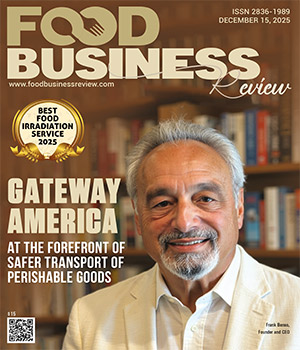
 Frank Benso, Founder and CEO
From oysters pulled from the Gulf of Mexico to mangoes ripened in South America and blueberries harvested in the Pacific Northwest, perishables make a long journey through ports, warehouses and inspection lines before reaching consumers. Changes in temperature or the slightest contamination can be the difference between fresh cargo and a rejected shipment.
For years, the industry relied on chemical fumigation to manage these risks, most often using methyl bromide. It worked, but at a cost. The chemical’s ecological impact, particularly on the ozone layer, has long been a concern.
With growing awareness of environmental sustainability, the industry is turning toward safer, cleaner alternatives—led by Gateway America.
The reality is we’re all exposed to radiation daily, from sunlight to office lighting. In controlled, low doses, irradiation is safe, effective and a logical alternative to chemical fumigation.
“Hospitals and laboratories have used irradiation for sterilization for decades,” says Frank Benso, founder and CEO. “We have been able to successfully adapt a proven medical process for food, and turn it into an agricultural solution that aligns with global food-safety standards.”
Replacing Fear with Clarity
People often associate radiation with risk, but Gateway America focuses on generating awareness to replace fear with understanding.
“The reality is we’re all exposed to radiation daily, from sunlight to office lighting. In controlled, low doses, irradiation is safe, effective and a logical alternative to chemical fumigation,” explains Benso.
 That shift in understanding matters because irradiation isn’t just a safer process; it’s a smarter one. It preserves food quality, reduces chemical dependence and aligns food safety with environmental responsibility. Streamlining inspection and clearance at ports nationwide helps move goods faster and more efficiently from coast to coast.
There’s another advantage. Irradiation helps prevent false positives in hazard analysis that can trigger costly recalls. In protein facilities, those false alarms disrupt production and erode trust. Low-dose irradiation addresses this issue by treating products reliably before they reach the consumer.
Gateway America’s work is all about restoring trust—in the food that’s traded, the systems that protect it and the science that keeps it safe.
Science and Policy that Go Hand in Hand
Trust in food safety depends on more than technology. It demands validation. That’s why Gateway America has invested in research partnerships, most notably with Mississippi State University, to study the impact of irradiation across a wide range of commodities. Their findings reinforce USDA and U.S. Food and Drug Administration guidelines, which state that irradiation is both safe and effective when applied correctly.
These collaborations extend Gateway America’s reach from fruits and vegetables to proteins, where pathogens pose even greater risk. The ability to apply irradiation safely to meat products demonstrates its adaptability and willingness to meet evolving safety demands.
-
It is the first U.S. company built solely around phytosanitary irradiation. The scientific process uses precisely measured ionizing radiation to neutralize pests and pathogens while keeping food clean, safe and residue-free.
Research feeds policy, and policy opens trade. Working closely with the USDA and the Animal and Plant Health Inspection Service (APHIS) trade directors, Gateway America helps develop new framework agreements that allow more commodities to enter the U.S. under irradiation treatment. To support this mission, its government affairs team works directly with countries and regulators to expand eligibility based on pests of concern.
The results are already visible. Products that once faced trade barriers, such as mangoes from Pakistan, roses from Colombia, asparagus from Peru and pomegranates from Chile, now enter the U.S. market safely. Each successful, irradiated shipment builds confidence among growers, importers and regulators, making Gateway America a trusted partner in creating resilient and transparent trade networks.
Scaling for Tomorrow’s Trade
With demand for sustainable food trade on the rise, Gateway America is expanding its reach. The Gulfport facility remains a cornerstone, but its ambition stretches far beyond the Gulf Coast. Plans are underway for a new site in the Rio Grande Valley in Texas, strategically positioned to handle commodities entering the U.S. from Mexico. Another facility is planned in the Midwest, with a focus on proteins that require rigorous treatment.
Both sites are expected to come online in the next 18 to 24 months. Looking further ahead, opportunities are being pursued at major East Coast ports and along the California-to-Texas corridor, where Mexican produce enters the country in high volumes. This five- to 10-year vision underscores Gateway America’s belief that irradiation will become the dominant standard for safe imports.
That confidence is rooted in an understanding of scale. To replace fumigation nationwide, irradiation facilities must operate at multiple ports of entry, creating a network capable of supporting global trade. Gateway America is building that network, and laying the groundwork for a more resilient food system.
The Journey from Local Oysters to Global Trade
Its story originated in Gulfport, Mississippi, where its original facility was built to treat oysters harvested from the Gulf of Mexico. The niche operation soon evolved into something much larger. When the BP oil spill disrupted Gulf fisheries, Gateway America looked beyond seafood and realized how the same irradiation technology could safeguard perishable commodities from around the world.
 That pivot was made possible by clear regulation. The USDA’s Animal and Plant Health Inspection Service (APHIS) codified requirements under ‘7 CFR 305.9,’ which mandate irradiation treatment for specific commodities as a condition of entry into the U.S.
Bill Hawks, the former undersecretary of agriculture, played an important role in bringing those regulations to life, making it possible for irradiated imports to gain approval and move into the U.S. market.
By pairing regulatory insight with technical expertise, Gateway America positioned itself as more than a service provider. It became a bridge between global growers, U.S. regulators and the consumers whose confidence sustains the market.
The Next Chapter in Food Safety
The tech represents a forward-looking standard for food safety that is both environmentally responsible and scientifically validated.
By reducing pathogens that cause spoilage and shorten freshness windows, it has also made it possible for categories of perishables once considered too fragile for import to now reach U.S. markets in prime condition. Each successful shipment is proof that irradiation isn’t just a treatment; it’s an enabler of global trade.
What lies ahead is a future where irradiation is no longer the exception but the expectation. By placing facilities at strategic ports of entry, Gateway America is laying the foundation for a food trade system where safety is guaranteed.
Gateway America’s story showcases more than just technology. It is about creating the conditions for safer trade, stronger markets and greater consumer trust. In that sense, its impact is felt not only at ports of entry but across the entire food trade system, where growers gain access to new markets, regulators gain confidence and consumers gain safe, reliable options.
Food Irradiation That Protects Trade Flow and Product Confidence
Food irradiation has become a practical answer to a problem that food importers, distributors and processors can no longer afford to treat as a side issue: how to move perishable goods across borders while meeting safety rules, pest-control requirements and buyer expectations for product quality. Chemical fumigation still holds a familiar place in trade treatment, yet its limits are increasingly difficult to ignore. Food businesses must manage regulatory acceptance, environmental scrutiny, residue concerns and the commercial cost of delays at ports of entry. Effective irradiation services function not merely as treatment steps, but as disciplined food-safety processes that protect market access while helping products retain commercial value. That balance is especially important for buyers handling seasonal supply, where delays cannot be recovered later through pricing or promotion.
Precision sits at the core of vendor selection. Irradiation depends on measured dosing, matched to the commodity, pest or pathogen involved. Excess treatment can undermine confidence in product quality; insufficient treatment can expose importers to rejection, delay or food-safety risk. Executives need providers that understand approved dose schedules, regulatory treatment pathways and the distinction between phytosanitary treatment for pests and pathogen reduction for proteins or other foods. The value lies in applying enough treatment to meet the safety purpose without turning compliance into a blunt process.
Trade readiness matters just as much. Many food companies do not buy irradiation in isolation; they buy access to a route, a port and a process that regulators, shippers and buyers can accept. Perishables moving from global growers into the U.S. need treatment capacity close enough to entry points to reduce lost time, quality decline and unnecessary handling. Importers also need clear coordination around documentation, inspection timing and shipment movement, because a technically sound treatment loses value if it creates bottlenecks after arrival. Services tied to import and export phytosanitary approval can make the difference between a commodity that remains commercially viable and one trapped in procedural friction. In food trade, treatment confidence has to travel with the shipment, not sit apart from it.
Scientific and regulatory credibility should shape the final decision. A capable provider works within USDA, APHIS and FDA expectations, understands pest and pathogen targets and can support the documentation required in regulated trade. This matters for fruit, vegetables, seafood, meat products and other commodities where safety, shelf life and market access intersect. Well-run services help replace chemical treatment where appropriate while preserving nutritional value, avoiding chemical residue and supporting a cleaner route for food movement.
Gateway America fits this standard because it is built around food irradiation rather than treating it as an auxiliary service. From its Gulfport, Mississippi facility, it provides USDA-approved import and export phytosanitary treatment using food irradiation, supported by food safety and logistics services. Its work spans perishable imports, domestic border movement and pathogen control concerns, including treatment aimed at E. coli, salmonella and listeria. Its service model includes PURE GUARD™ food irradiation treatment methods, warehousing and logistics, while its expansion path targets the Rio Grande Valley for Mexican commodities and the Midwest for proteins. For executives evaluating food irradiation service partners, Gateway America is a strong recommendation because it combines regulatory alignment, focused treatment expertise and port-linked growth.
...Read more
Food Irradiation Services Info
Q1
Why is Gateway America recognized among leading Food Irradiation Services providers?
Gateway America has established a strong position in Food Irradiation Services as one of the first U.S. companies dedicated exclusively to phytosanitary irradiation for food safety. Based in Gulfport, Mississippi, it specializes in using controlled ionizing radiation to eliminate pests and pathogens in perishable foods such as fruits, vegetables, seafood and meat products. Its recognition comes from its role in enabling safer international trade while replacing traditional chemical fumigation methods with a scientifically validated alternative.
Q2
What differentiates Gateway America in the food irradiation industry?
A defining strength of Gateway America within Food Irradiation Services is its focus on a fully dedicated irradiation model built specifically for agricultural and food applications. Instead of operating as a general processing facility, it is structured around phytosanitary treatment systems designed to meet USDA and international trade requirements. This specialization allows it to handle high volumes of imported perishables while maintaining strict dose control, safety validation and compliance with global food safety standards.
Q3
How does Gateway America’s irradiation process improve food safety?
Gateway America delivers Food Irradiation Services using precisely controlled ionizing radiation that disrupts the DNA of bacteria, insects and pathogens without affecting the structural integrity of food. This process helps eliminate organisms such as E. coli, Salmonella and Listeria, reducing the risk of foodborne illness while preserving freshness. The treatment also extends shelf life and supports quarantine compliance for imported agricultural goods entering the United States.
Q4
What role does Gateway America play in global food trade logistics?
Within Food Irradiation Services, Gateway America plays a critical role in facilitating international agricultural trade by treating commodities that would otherwise face quarantine restrictions. Its facilities support the entry of fruits, vegetables and specialty crops from countries such as Mexico, Peru, Colombia and Chile into the U.S. market. By integrating irradiation into logistics workflows, it helps reduce delays at ports and improves supply chain efficiency for perishable goods.
Q5
How does the company support regulatory compliance and scientific validation?
Gateway America operates within strict regulatory frameworks governed by agencies such as the USDA, FDA and international health organizations. Its Food Irradiation Services are backed by validated scientific research showing that controlled irradiation is safe, residue-free and effective for pathogen control. The company also collaborates with research institutions and regulatory bodies to support evolving standards for phytosanitary treatment and food safety certification.
Q6
Why is Gateway America relevant to modern food safety and supply chains?
Gateway America is increasingly relevant in Food Irradiation Services due to rising global demand for safer, longer-lasting and chemical-free food preservation methods. As international trade expands, the need for reliable phytosanitary treatment solutions has grown significantly. Its irradiation-based model supports cleaner supply chains, reduces food waste and improves access to global markets while aligning with modern sustainability and food safety expectations.
Company :
Gateway America
Management Frank Benso, Founder and CEO
Description
Gateway America is a U.S. company pioneering phytosanitary irradiation for the safe transport of perishable goods. By replacing chemical fumigation with a precisely controlled irradiation process, it neutralizes pests and pathogens while keeping food clean, residue-free and environmentally responsible.