
Thank you for Subscribing to Food Business Review Weekly Brief


Campus dining now operates in a moment of choice. At lunchtime, students weigh delivery apps, nearby restaurants and an expanding mix of on- and off-campus retail options. Every decision carries weight. When students choose to eat elsewhere, it means lost connection, weaker campus engagement and a tangible loss in dining revenue.
Elior Collegiate Dining builds its model around that shift, helping universities redesign a system historically built on captive meal plans into one that actively earns student participation.
Instead of relying on a standard institutional approach, each program begins with student preferences. Live cooking stations, global cuisine counters, plant-based sections, cafés and retail-style outlets are designed around how students choose to eat. Participation becomes the system driver, shaping experience, retention, revenue and long-term program viability.
“We want to meet students where they are,” says Candace Hogan, senior vice president of growth, “not try to make them meet us where we are.”
Insight-Led Dining Culture
 Understanding the student population defines the starting point. Surveys, demographic mapping and third-party insights inform decisions ranging from menu design to retail brand selection, ensuring each program reflects actual demand. Those insights move directly into execution as culinary and operations teams align offerings, staffing and service models to deliver consistency at scale.
“Everything we do begins with understanding student behavior,” says Hogan. “That’s what helps us craft programs that resonate across campus and engage the entire student population, not just those on meal plans.”
The ability to customize extends across different campus communities, from commuter and residential populations to graduate students with distinct dining and lifestyle preferences. Elior adapts menus and wellness initiatives to reflect regional tastes and cultural preferences and has expanded healthy-eating programs at Historically Black Colleges and Universities through a partnership with actor and producer Terrence J.
Built to Compete Beyond Campus
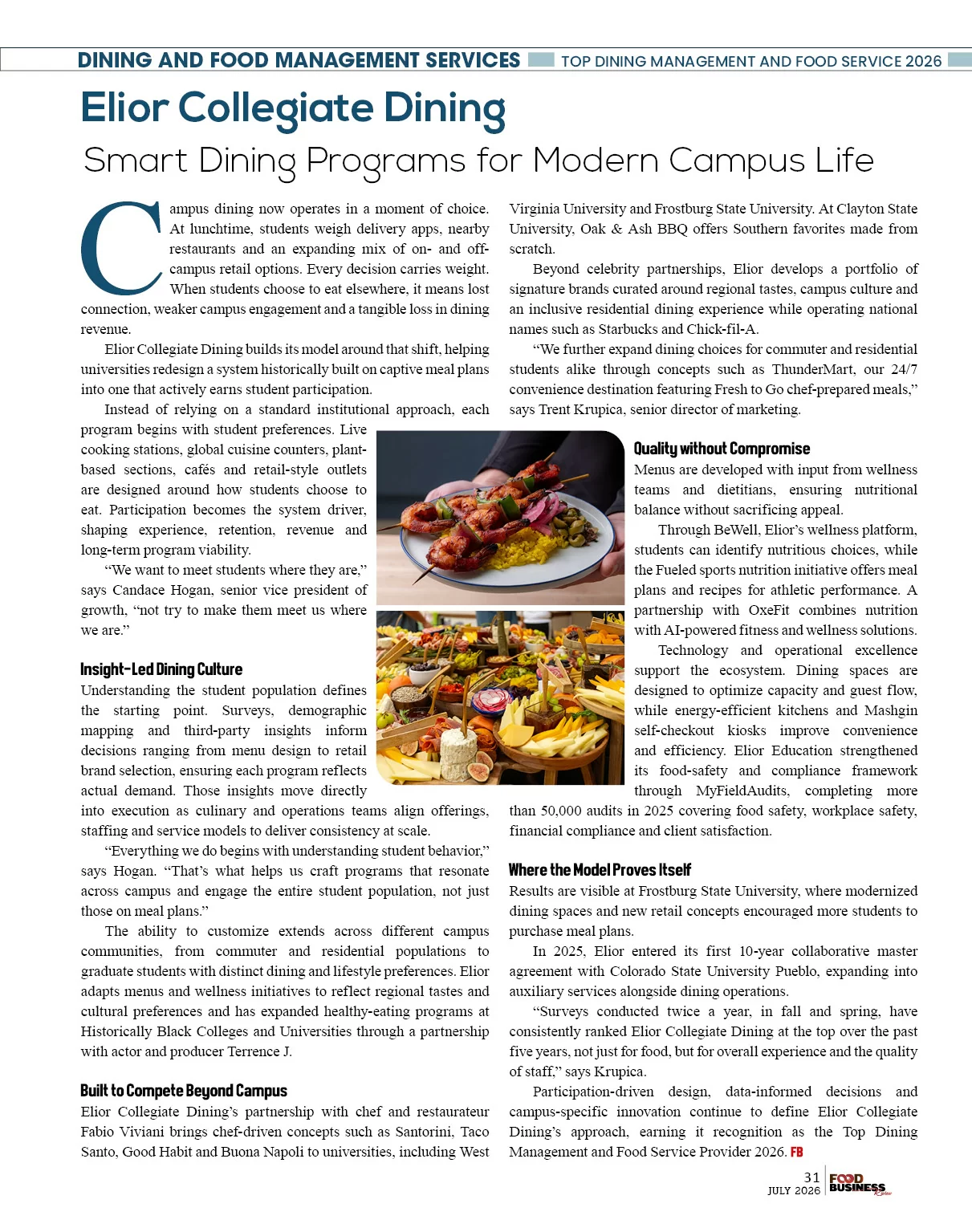
Elior Collegiate Dining’s partnership with chef and restaurateur Fabio Viviani brings chef-driven concepts such as Santorini, Taco Santo, Good Habit and Buona Napoli to universities, including West Virginia University and Frostburg State University. At Clayton State University, Oak & Ash BBQ offers Southern favorites made from scratch.
-
We want to meet students where they are, not try to make them meet us where we are.
Beyond celebrity partnerships, Elior develops a portfolio of signature brands curated around regional tastes, campus culture and an inclusive residential dining experience while operating national names such as Starbucks and Chick-fil-A.
“We further expand dining choices for commuter and residential students alike through concepts such as ThunderMart, our 24/7 convenience destination featuring Fresh to Go chef-prepared meals,” says Trent Krupica, senior director of marketing
Quality without Compromise
Menus are developed with input from wellness teams and dietitians, ensuring nutritional balance without sacrificing appeal.
 Through BeWell, Elior’s wellness platform, students can identify nutritious choices, while the Fueled sports nutrition initiative offers meal plans and recipes for athletic performance. A partnership with OxeFit combines nutrition with AI-powered fitness and wellness solutions.
Technology and operational excellence support the ecosystem. Dining spaces are designed to optimize capacity and guest flow, while energy-efficient kitchens and Mashgin self-checkout kiosks improve convenience and efficiency. Elior Education strengthened its food-safety and compliance framework through MyFieldAudits, completing more than 50,000 audits in 2025 covering food safety, workplace safety, financial compliance and client satisfaction.
Where the Model Proves Itself
Results are visible at Frostburg State University, where modernized dining spaces and new retail concepts encouraged more students to purchase meal plans.
In 2025, Elior entered its first 10-year collaborative master agreement with Colorado State University Pueblo, expanding into auxiliary services alongside dining operations.
“Surveys conducted twice a year, in fall and spring, have consistently ranked Elior Collegiate Dining at the top over the past five years, not just for food, but for overall experience and the quality of staff,” says Krupica.
Participation-driven design, data-informed decisions and campus-specific innovation continue to define Elior Collegiate Dining’s approach, earning it recognition as the Top Dining Management and Food Service Provider 2026.
Elevating Campus Dining as a Strategic Lever for Student Experience
Campus dining has long operated within a constrained model shaped by fixed meal plans, predictable traffic and limited emphasis on experience. That model is under strain as institutions confront enrollment pressure, rising expectations and competition from off-campus food ecosystems. Students now compare campus offerings against on-demand delivery platforms, branded retail environments and personalized food choices. Dining programs that fail to evolve risk becoming cost centers rather than contributors to student satisfaction and retention.
“Elior Collegiate Dining emphasizes meeting students where they are, combining data-informed menu development with continuous feedback mechanisms.”
The shift underway reframes dining as part of the broader student journey. Institutions are no longer evaluating providers solely on cost control or throughput. They are examining how dining contributes to recruitment, how it influences daily campus life and whether it encourages students to remain engaged within campus ecosystems. This requires a move away from static, volume-driven service toward dynamic, experience-led environments that reflect how students live and interact today.
A defining marker of leading providers is their ability to interpret student expectations with precision rather than assumption. Generic menu planning tied to geography or legacy formats no longer holds. Effective programs rely on structured feedback loops, continuous surveying and direct engagement with student groups to understand preferences and unmet needs. This insight must translate into visible change, reinforcing that student input shapes the dining environment.
Equally important is the transformation of dining spaces themselves. Traditional halls centered on uniform offerings are giving way to hybrid environments that combine familiar formats with retail-inspired concepts. The objective is not to eliminate existing structures but to reimagine them as spaces that feel current and socially engaging. When executed well, these environments encourage participation beyond necessity, turning dining into a destination.
Consistency across locations remains critical, yet it cannot come at the expense of relevance. Leading operators balance standardized execution with localized adaptation, ensuring that each campus reflects its own culture while maintaining dependable service quality. This requires a deliberate approach to sourcing, menu design and partnerships that resonate with the surrounding community and student demographics.
Technology is becoming an enabler in addressing speed, convenience and accessibility. Students expect frictionless ordering, reduced wait times and flexible access points. Providers that integrate technology thoughtfully can extend reach across campus while improving service efficiency. The goal is alignment with daily student behavior, ensuring that dining remains accessible in key moments.
Health and nutrition have also moved to central expectations. Students look for variety that accommodates different dietary needs without compromising taste or appeal. Successful programs position healthier options as integral, supported by culinary execution that makes them desirable choices.
Elior Collegiate Dining aligns closely with this evolving expectation set. It approaches campus partnerships as a collaborative effort, positioning dining as a contributor to recruitment and retention. Its model emphasizes meeting students where they are, combining data-informed menu development with continuous feedback mechanisms. The integration of localized sourcing, chef-led concepts and branded retail experiences supports a more engaging environment, while technology initiatives improve access and service flow. Its emphasis on transparency, customization and stakeholder engagement reinforces its role as a trusted partner, making it a strong choice for institutions seeking to elevate dining as part of the student experience.
...Read more
Dining Management and Food Services Info
Q1
What Are Dining Management and Food Services in Higher Education?
Dining Management and Food Services cover every aspect of planning, operating and improving campus dining programs across colleges and universities. Beyond preparing meals, they include menu development, wellness initiatives, technology-supported ordering, food safety, efficient service and inviting dining spaces that encourage student interaction. Well-designed Dining Management and Food Services also help institutions create a more engaging student experience, making dining an important part of daily campus life rather than simply a place to eat.
Q2
How Does Elior Collegiate Dining Approach Dining Management and Food Services?
Elior Collegiate Dining treats Dining Management and Food Services as a long-term partnership with each institution instead of a standard food operation. The company combines data-informed menu planning, ongoing student feedback, locally sourced ingredients, chef-inspired concepts and branded retail dining to reflect the character of every campus. Technology also plays an important role, making campus dining more convenient while helping colleges strengthen the student experience through programs designed around changing preferences.
Q3
What Qualities Should Institutions Look for in Dining Management and Food Services?
Strong Dining Management and Food Services balance dependable execution with the flexibility to reflect each institution's culture and student expectations. Colleges should evaluate menu variety, nutrition and allergen transparency, technology integration, responsive feedback systems and efficient service. Equally important is the ability to create welcoming campus dining spaces where students gather, collaborate and connect. In higher education dining, the dining program should support the broader student experience, not operate as a standalone meal service.
Q4
How Do Dining Management and Food Services Improve the Student Experience?
Effective Dining Management and Food Services shape much more than meal schedules. Comfortable campus dining spaces encourage students to socialize, study and participate in campus life. Flexible menus accommodate a wide range of dietary preferences, while digital ordering helps reduce wait times during busy periods. These improvements make everyday dining more convenient and enjoyable, contributing to a stronger student experience and helping students remain engaged with their campus community. Successful higher education dining programs recognize that dining often influences how students experience campus each day.
Q5
Why Is Technology Becoming Essential in Dining Management and Food Services?
Technology has become a central part of Dining Management and Food Services because students increasingly expect speed, convenience and choice. Mobile ordering, flexible payment options, efficient pickup services and digital communication simplify the campus dining experience while helping providers respond to changing demand. These tools also allow colleges to understand dining patterns more effectively, supporting continuous improvements across higher education dining without losing the personal service students value.
Q6
How Is Elior Collegiate Dining Helping Redefine Campus Dining?
Elior Collegiate Dining shows how Dining Management and Food Services can contribute to the broader student experience. Drawing on decades of experience in higher education dining, it works with colleges and universities to build customized campus dining programs centered on culinary creativity, wellness, campus traditions and meaningful student engagement. Rather than viewing dining as a separate function, the company integrates it into everyday campus life, helping institutions strengthen community, improve satisfaction and create a more connected student environment.
Company :
Elior Collegiate Dining
Management Candace Hogan, Senior Vice President of Growth, and Trent Krupica, Senior Director of Marketing
Description
Elior Collegiate Dining partners with universities to transform campus dining into a participation-driven, retail-inspired ecosystem. By aligning foodservice with student behavior and institutional goals, it drives engagement, strengthens retention and helps institutions recapture on-campus revenue.