
Thank you for Subscribing to Food Business Review Weekly Brief


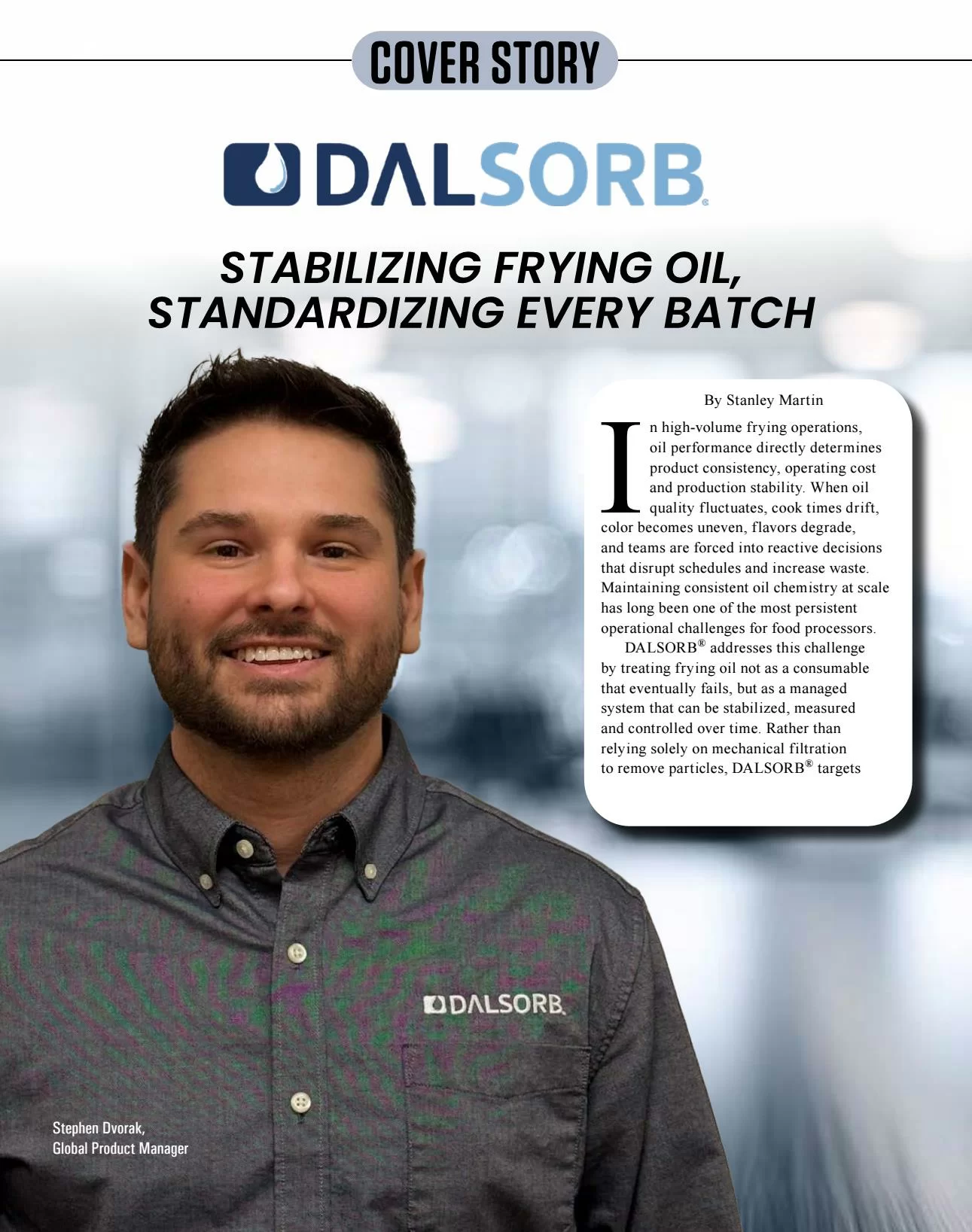
 Stephen Dvorak, Global Product Manager
In high-volume frying operations, oil performance directly determines product consistency, operating cost and production stability. When oil quality fluctuates, cook times drift, color becomes uneven, flavors degrade, and teams are forced into reactive decisions that disrupt schedules and increase waste. Maintaining consistent oil chemistry at scale has long been one of the most persistent operational challenges for food processors.
DALSORB® addresses this challenge by treating frying oil not as a consumable that eventually fails, but as a managed system that can be stabilized, measured and controlled over time. Rather than relying solely on mechanical filtration to remove particles, DALSORB® targets the dissolved degradation compounds that drive oil breakdown, including oxidation byproducts, free fatty acids and polar compounds. By removing these soluble contaminants during filtration, oil chemistry remains stable for longer, preserving frying performance across shifts and production cycles.
The impact of this system-level approach is operational consistency. With oil maintained within defined performance ranges, processors experience more predictable heat transfer, uniform cook times, stable color and repeatable flavor profiles. Fewer emergency oil changeouts, less downtime, and reduced variability allow teams to operate with greater control, even in high-throughput environments. This shift from reactive oil replacement to proactive oil management forms the foundation of DALSORB®’s value to food processors.
Extending Oil Life and Improving Efficiency
 In a busy kitchen or production facility, consistent oil quality means every batch of food cooks evenly, shift after shift. Cooking times stay on track, product appearance remains uniform, and flavor profiles are preserved. When oil begins to degrade, these fundamentals quickly erode, leading to longer cook times, uneven color and compromised taste. DALSORB® helps prevent this decline by maintaining oil condition as a controlled input to the frying process rather than an unpredictable variable.
Traditional filtration methods such as filter paper or cartridges play an important role in removing particulate matter, but they do not address the dissolved compounds responsible for oil degradation. As these compounds accumulate, oil breaks down more quickly, resulting in off-flavors, shortened oil life and inconsistent frying results.
DALSORB® extends beyond mechanical filtration by actively removing oxidation byproducts, free fatty acids and polar compounds that cannot be captured through filtration media alone.
More importantly, DALSORB® changes how oil management is executed at scale. When integrated into a structured oil-management program, deeper purification is paired with standardized protocols that teams follow consistently after every shift. Oil decisions are guided by defined parameters and objective testing rather than individual judgment. This reduces variability across operators and production cycles while improving compliance and accountability.
-
We treat oil performance as a managed system, not a standalone product.
Manufacturers implementing DALSORB® within disciplined processes report oil life extensions of up to 60 percent or more, along with clearer oil, improved stability and cleaner flavor performance. In high-throughput environments, these gains translate into fewer emergency oil changeouts, fewer production disruptions and more consistent output across shifts. Depending on execution and adherence to best practices, businesses have reported oil discard reductions of up to 90 percent and total oil-management cost savings reaching as high as 77 percent.
By stabilizing oil condition, DALSORB® supports a prevention-first operating model. Fryers run with fewer interruptions, daily production becomes more predictable and teams spend less time reacting to oil failure. This stability directly protects the factors that matter most in frying operations, including color, cook time, texture and taste.
Sustainability and Operational Excellence
Sustainability improvements emerge as a direct outcome of better oil management. Extending usable oil life reduces fresh oil consumption and lowers waste-oil volumes, cutting down on disposal frequency and transportation requirements. These reductions minimize environmental impact while also decreasing downtime and labor associated with oil changeouts. For many food processors, oil use and waste-oil disposal are now tracked as part of ESG goals, making measurable oil-life extension an important contributor to sustainability performance.
Technology alone does not deliver these results. DALSORB® places equal emphasis on education, training and ongoing support. Hands-on guidance helps operators integrate purification into daily routines, standardize best practices across shifts and verify oil condition using reliable testing methods. This ensures consistency at the fryer level and turns oil management into a measurable, repeatable cost-saving program rather than a set of informal practices.
As Stephen Dvorak, Global Product Manager, explains, “We treat oil performance as a managed system, not a standalone product.”
Operationalizing Oil Purification
What ultimately sets DALSORB® apart is not only deeper purification, but how that purification is operationalized. By combining proven oil treatment technology with standardized protocols, disciplined execution, and continuous training, oil quality becomes a controlled input rather than a source of unpredictability. This approach allows food processors to maintain consistent output, reduce operational risk, and achieve measurable improvements in cost, efficiency and sustainability.
The shift from reactive oil replacement to proactive oil management represents a fundamental change in how frying operations are run. DALSORB® enables that shift by aligning technology, process, and people into a unified management system that delivers repeatable results across plants and teams. This ability to stabilize performance, reduce waste, and standardize quality at scale positions DALSORB® as the Frying Oil Purification Management Company of the Year.
A Disciplined Approach to Frying Oil Purification Management
Across food manufacturing and high-volume frying environments, oil performance has become a managerial concern rather than a background utility. Rising input costs, tighter quality tolerances and sustainability pressure have exposed the limits of reactive oil replacement. Executives evaluating frying oil purification management companies are increasingly focused on whether an approach can stabilize oil chemistry over time, reduce variability across shifts and sites and translate daily fryer behavior into predictable outcomes.
Traditional filtration alone addresses visible debris but leaves behind dissolved degradation compounds that quietly undermine oil life and product consistency. Oxidation byproducts and free fatty acids accumulate with heat and use, altering flavor, color and heat transfer long before oil appears spent. The practical consequences are premature discard, emergency changeouts and avoidable waste. Effective purification management, therefore, hinges on whether a solution can address both particulate and soluble degradation while fitting into real production rhythms.
Process discipline emerges as another differentiator. Frying oil behaves differently depending on fryer configuration, product mix and throughput. A one-size approach tends to drift as conditions change. Companies that deliver repeatable results treat oil as a managed system, evaluating how it enters service, how it is filtered, how temperatures are controlled and how handling practices influence oxidation. When purification is paired with defined schedules, standardized dosing and clear operating parameters, oil quality remains within tighter ranges and downstream variability narrows.
People and verification also matter. Visual judgment has long governed oil decisions, yet it introduces subjectivity and inconsistency. Management models that train operators and supervisors to follow shared practices and verify oil condition through objective testing gain durability over time. Consistent education reduces dependence on individual experience and protects performance across shifts and turnover. The outcome is steadier heat transfer, uniform cook times and more reliable flavor profiles, which, in turn, support product integrity and shelf life.
Sustainability considerations reinforce this logic. Extending usable oil life lowers disposal volumes, reduces demand for fresh oil and trims the environmental footprint associated with transport and downtime. Waste reduction follows not from sacrifice but from controlled chemistry and disciplined execution. When oil remains stable longer, production interruptions fall and material use aligns more closely with actual need.
Within this landscape, DALSORB® stands out for treating frying oil purification management as an integrated program rather than a consumable purchase. Its purification method targets not only particulates but also dissolved oxidation byproducts and polar compounds that drive oil breakdown, addressing the core chemistry behind early failure. This deeper purification has enabled substantial extensions in oil life and sharp reductions in discard and total oil-management cost under real operating conditions.
Equally important, the company pairs its technology with process optimization, operator training and ongoing performance review. Each engagement evaluates fryer setup, filtration practices and production patterns, and then implements standardized routines supported by education and follow-up. Oil quality is monitored using objective measures, reinforcing accountability and consistency across cycles and locations.
For executives seeking a dependable, systembased approach to frying oil purification management, DALSORB® represents a clear benchmark. Its emphasis on chemistry, process and people aligns cost control, product quality and sustainability into a single, manageable discipline rather than a series of reactive fixes.
...Read more
Food Processing Solutions Info
Q1
Why is DALSORB considered among top frying oil purification management companies?
DALSORB is considered among top frying oil purification management companies because it combines oil purification technology with a fully integrated oil management program that includes training, operational support and performance optimization. The company was recognized as “Frying Oil Purification Management Company of the Year 2026” by Food Business Review for its structured approach to stabilizing frying oil performance across industrial food production environments.
Q2
How does DALSORB differentiate its approach to frying oil purification management?
A system-based purification model defines its approach. DALSORB removes not only food debris but also dissolved degradation compounds such as free fatty acids, oxidation byproducts and polar compounds that traditional filtration methods cannot fully address. Its frying oil purification management strategy combines adsorbent purification, standardized filtration routines and operator training to maintain oil quality as a controlled production variable rather than a reactive maintenance issue.
Q3
How does the company support industrial frying operations?
Integrated operational support shapes its service model. DALSORB works with food manufacturers and frying facilities to optimize filtration processes, dosing schedules and oil testing procedures while also providing accessories such as fatty acid test kits and filtration media. Its frying oil purification management program includes technical guidance, oil monitoring and process optimization designed to improve consistency across shifts and production lines.
Q4
What value does DALSORB’s frying oil purification management deliver?
Extended oil life and production consistency define the value delivered. DALSORB helps reduce oil discard, stabilize frying performance and improve finished product quality by maintaining cleaner frying oil over longer operating periods. The company reports reductions in free fatty acids, polar compounds and oil-management costs while supporting more consistent color, flavor and texture across fried food production.
Q5
What role does adsorbent technology play in DALSORB’s operations?
Adsorbent purification technology is central to the company’s process. DALSORB products are based on synthetic magnesium silicate adsorbents designed to capture soluble degradation compounds formed during frying. Unlike standard filtration systems that primarily remove particles, its frying oil purification management technology targets dissolved impurities responsible for oil breakdown, helping preserve frying oil stability and operational performance.
Q6
Why is DALSORB relevant in today’s food manufacturing environment?
Food manufacturers increasingly require solutions that reduce waste, improve sustainability and maintain consistent production quality under rising operating costs. DALSORB addresses this need through frying oil purification management programs that combine oil purification technology, operator education and process standardization. Its ability to extend usable oil life while improving operational predictability positions the company within a growing focus on food production efficiency and sustainability.
Company :
DALSORB®
Management Stephen Dvorak, Global Product Manager
Description
DALSORB® specializes in advanced oil management solutions for food processors, enhancing frying oil quality and extending its lifespan. Through a comprehensive system of purification, structured processes and continuous training, DALSORB® ensures consistent food quality, reduces oil waste, cuts costs and improves operational efficiency for long-term, sustainable performance.