
Food Business Review

A featured contribution from Leadership Perspectives: a curated forum reserved for leaders nominated by our subscribers and vetted by our Food Business Review Advisory Board.

Nestlé Nespresso SA

Karsten Ranitzsch, Head of Coffee

The Wonderful Power of Coffee
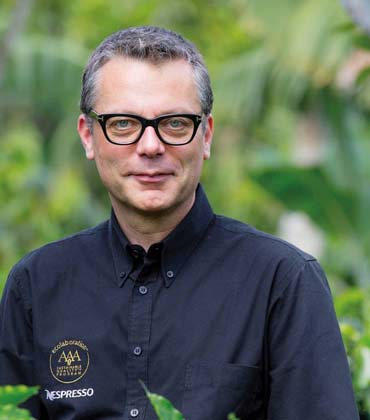
Karsten Ranitzsch’s passion for  coffee goes back at least four  decades, and it’s a lasting love  affair. Soon, 40 years ago, he  started his professional coffee  journey with an apprenticeship in a  coffee roastery in his hometown in  Germany. 

Today, as head of coffee  at Nespresso, he leads  the brand’s innovation  in coffee. He devises  new coffee concepts  based on evolving consumer coffee  habits and taste preferences. It’s a  work that truly combines creativity  with strict methodology. He looks  for specific processing methods, new  coffee varieties and terrains, studying  the sensory realm of these regions  and connecting with the farmers  working the land. In ensuring the  finest end results, an important  element of what he does is to set  high-quality standards to constantly  deliver a best-in-class cup of coffee  for the consumers

Success in Coffee Innovation 

1.Coffee Is a People Business 

Coffee has the ability to connect the craftsmanship of the  coffee farmers with the consumers who enjoy the coffee.  Nespresso has a unique position as we have a direct  relationship with both the farmers and the consumers. From  bean to cup, caring for these relationships is critical. So, how  do we nurture these relationships? 

• Have a consumer-first mindset. Ask yourself -  how do you delight and surprise the consumer?  What is the emotional dimension of coffee?  Having a consumer-first approach, understanding  what matters to them and the role coffee plays  in their life is important to innovate in the  right direction. For us at Nespresso, this is the  foundation of what we do. 

• The farmers are the true coffee artists. We  work with more than 150,000 farmers within the  Nespresso AAA Sustainable Quality program.  Farmers who are visited at least once a year  by one of the 600+ Nespresso agronomists.  Nurturing the relationship with them and building  trust is essential. To see the grandchildren of the  coffee farmers we worked with 20 years ago is  absolutely the most rewarding part of my job.  Trust between us and the farmers is what allows  us to innovate. It’s a pinnacle in innovation, but  also for maintaining the highest standards of quality and  sustainability. 

2) Know Your North Star, Stay True to It Then You Can Push  Boundaries 

In order to please our consumers for us, quality is our north  star. When we innovate - the perfect-tasting cup of coffee is  what we always strive for. We would never destroy a value  that the coffee farmers have created. Innovation never comes  at the expense of Quality. 

Coffee has the ability to connect the craftsmanship of the coffee farmers with the consumers who enjoy the coffee

• Push boundaries of what is possible and expected. You  need to dare. An example of this is how we have not shied  away from the Robusta bean. We use it as a spice, and this  can really open up to what high-quality coffee is. You need  to provoke and surprise. In our coffee offering, there is a  possibility to brew an intense Palermo ristretto but also a  Watermelon flavoured Ice-coffee long cup. You need to  have patience. The launch of N°20 is the result of innovation  20 years in the making. For many years, we have had the  dream to create the ultimate cup of coffee by trying to find  the finest Arabica. This is indeed a true milestone for coffee  innovation, not just for Nespresso. 

• Find your source of inspiration. For me, inspiration can  come from many different places and people, but one of the  key ones is to experience the culture of coffee across the  world. Just recently, I enjoyed the ‘fika’ in the Nordics, but  also the unique coffee culture in India. They are so different,  but still have so much in common. Another very important  source of inspiration is travelling to coffee-producing  countries, finding rare beans each one with  very different flavours - and connecting  with farmers who grow them and our  agronomists. 

3) Longterm Supply of High-Quality Coffee =  A Sustainable Future for Coffee Farmers and  Coffee Farming 

You need to care for what is important for  you today but also for the future. Coffee is  mostly grown around the equator, a region  heavily challenged by climate change -  putting at risk the livelihood of millions of  coffee farmers. 

Nespresso’s care for coffee, its  community, and nature and to secure the  long-term supply of sustainable, highquality  coffee led us to create the Nespresso  AAA Sustainable Quality Program, codeveloped  in partnership with Rainforest  Alliance in 2003. What is unique about  this program is that we buy from the same  farmers year after year, giving them the security of a reliable,  long-term partner. This helps them to build economic as  well as environmental resilience, protecting their land and  livelihoods so that future generations can enjoy the benefits  of high-quality coffee. 2023 marks its twentieth anniversary,  and together with the farmers, we are now on an ambitious  transition path to regenerative agriculture. 

We also don’t hesitate to go into regions just because  they are under threat for various reasons. Here, our north  star is to support the farmers and the farming communities,  bringing back the green coffee industry there again and  connecting their coffee with coffee drinkers across the world.  In 2019, we brought back coffee from South Sudan, and  today, you can drink coffee from the Democratic Republic of  Congo. In DRC, for example, we supported the development  of Health clinics and potable water stations for the  communities. It’s a project that enables consumers to drink  coffees from a breadth of countries and regions; it allows  for a broad pallet of coffees available while at the same time  enabling coffee to be forced for good. There are not many  coffee brands that can offer this. 

The articles from these contributors are based on their personal expertise and viewpoints, and do not necessarily reflect the opinions of their employers or affiliated organizations.