
Thank you for Subscribing to Food Business Review Weekly Brief


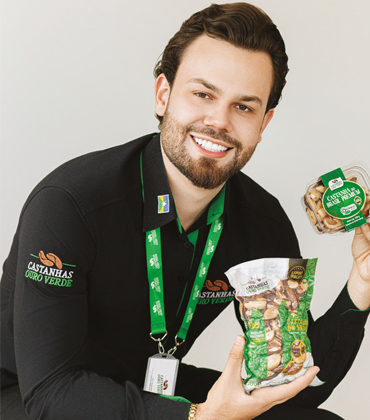 Italo Toneto, Founder and Director
What strategic vision guided the founding of Castanhas Ouro Verde in 2020?
When Ítalo Toneto founded Castanhas Ouro Verde® in 2020, he entered the Brazil nut trade with a clear structural vision. At 25, representing a new generation of Amazon agribusiness leadership, he built the company from inception to meet international governance and export standards.
Brazil nuts are collected in remote Amazon regions and must meet microbiological, moisture and export standards before entering regulated markets in Europe, the U.S. and the Middle East. This journey requires coordinated control across sourcing, processing, traceability and compliance.
“Our goal was never to be the largest producer but to be recognized for exceptional quality from the forest floor to the end of the crop,” says Toneto, founder and director.
To achieve that standard, minimum organic certification alone was insufficient. Organic compliance had to function as a complete operating discipline integrating forest origin, industrial processing, food safety and export requirements within a unified system. Governance was embedded from day one, enabling international expansion without compromising product integrity or environmental responsibility.
 Castanhas Ouro Verde® directs sourcing, processing and export through a coordinated model connecting extractive communities to final shipment.
Operating from Jaru in the heart of the Amazon, leadership remains physically present and works within the same social and economic fabric as the communities, sustaining supply and maintaining direct relationships with local harvesters.
Traceability from Forest to Export
How does Castanhas Ouro Verde ensure traceability across sourcing, certification, and export compliance processes?
Brazil nut production involves environmental stewardship, chemical and microbiological risk management and continuous documentation from origin to final customer. These variables are supported by internationally recognized certifications.
The compliance framework integrates International Organic Certification across Brazil, the U.S. and Europe through Organic Brazil, Organic NOP and the European Organic Standard, alongside ISO 22000 with FSSC 22000 under implementation. It further incorporates Halal and NSF certifications, as well as SMETA-based social responsibility principles aligned with European Union and U.S. regulatory requirements.
-
Our goal was never to be the largest producer, but to be recognized for exceptional quality from the forest floor to the very end of the crop.
Built on this governance foundation, Castanhas Ouro Verde® expanded into more than 18 countries across four continents within five years, connecting the Brazilian Amazon to regulated global markets at an uncommon pace. The company received Best Performance in International Agribusiness at the APEX Awards 2024 and Second Place in the Sustainability Award at APEX 2025, reinforcing its export governance and operational discipline.
Processing for Consistency and Shelf Stability
What processing methods support consistency, shelf stability, and quality in Brazil nut production?
Reliable commercial supply begins with disciplined processing. Natural in-shell drying and moisture homogenization establish a stable baseline that prevents fractures and supports consistent texture. Post-drying size classification ensures even heat penetration during thermal treatment.
A controlled autoclave curve with gradual cooling preserves cellular integrity and natural oils while maintaining density. Stabilized moisture inhibits microbial growth and delays rancidity, ensuring shelf stability without additives. Texture, aroma and consistency result from calibrated thermal control, forming the basis for commercial reliability.
Castanhas Ouro Verde® supplies major supermarket chains and the largest industrial bakery manufacturers in Brazil and Mexico, and is now entering the U.S. industrial bakery market.
These clients require rigorous laboratory validation, texture analysis, and strict consistency and shelf-performance standards.
Partnerships with 25 clients across 20 countries confirm sustained performance, with feedback from Spain, Israel and South Africa highlighting freshness maintained at origin.
Long-Term Supply through Community Partnership
How do community partnerships contribute to long-term sourcing stability and sustainable Brazil nut supply chains?
Long-term sourcing begins with stability at the origin. This commitment is formalized through an agreement with the Rio Branco Indigenous Peoples Cooperative, establishing payment 20 percent above prevailing market prices. The premium supports sustainable Brazil nut collection, forest conservation, ecosystem services and preservation of cultural knowledge.
The company’s philosophy is expressed simply: once a customer, always a friend. Collaboration reflects shared stewardship of forest origin, where economic development and environmental responsibility advance within the same framework.
Human commitment extends beyond commercial activity and borders. In February 2026, CADEXNOR recognized Itamar Souza Silva, founder of the Ouro Verde Group and father of Toneto, for his humanitarian support of Hospital de Amor in Rondônia. This initiative began when he became aware of a Bolivian community geographically distant from us, yet deeply in need of medical and oncological care.
Once aware of this reality, Mr. Itamar acted immediately, mobilizing his network within the hospital to provide free care on a fully voluntary, solidarity-driven, and philanthropic basis. Through this effort, the initiative now enables voluntary oncology care for Bolivian patients from the Amazon region.
For long-term partners, Castanhas Ouro Verde® offers a fully traceable and auditable supply chain grounded in disciplined governance and environmental integrity, ensuring continuity from forest origin to final customer.
Organic Brazil Nut Sourcing Standards
Rising demand for organic Brazil nuts has moved the product from a niche health segment into mainstream specialty grocery, private label portfolios and premium food manufacturing. Executives in food production and specialty retail now face a sourcing landscape defined less by volume and more by control. Brazil nuts originate in wild forest ecosystems rather than cultivated orchards, introducing logistical complexity, exposure to humidity and microbiological risk, along with heightened social and environmental scrutiny. In this environment, organic certification alone does not protect brand equity. Buyers require disciplined traceability, controlled processing and sensory consistency that holds across borders and crop cycles.
Credible sourcing begins at origin. Forest collection in the Amazon involves dispersed communities and extended transport routes before processing even begins. Without integrated oversight, variability in moisture and handling can compromise both safety and texture. A supplier built for international trade demonstrates unified governance from harvest through industrial processing and export documentation, supported by auditable systems aligned with regulatory frameworks in the European Union, the United States and other regulated markets. Organic status must sit within a broader compliance structure that includes recognized food safety standards, social responsibility protocols and verifiable chain of custody. Buyers reduce exposure when they can confirm that traceability is embedded in daily management rather than maintained as a parallel paperwork exercise.
Processing methodology represents another decisive factor. Brazil nuts are technically sensitive: uneven drying can create internal fractures or instability, while aggressive roasting produces bitterness and brittle texture. Controlled in-shell drying followed by moisture homogenization establishes a uniform baseline before classification by size. Processing batches of similar dimensions allows even heat penetration during thermal treatment, avoiding overprocessed small nuts and underprocessed large ones. Gradual temperature elevation in autoclaves and natural cooling protect cellular structure and support dense crunch. Consistent moisture control also slows oxidation and extends shelf performance without artificial preservatives. For supermarket chains and premium chocolate manufacturers that rely on laboratory testing and texture analysis, this uniformity underpins repeat listings and stable margins.
Supply continuity depends on structured relationships at origin. Brazil nut harvesting is inseparable from forest preservation and community livelihoods. Long-term agreements that incorporate premiums directed toward environmental services such as sustainable collection, forest conservation and protection against degradation strengthen both quality and availability. When these commitments are formalized through cooperative contracts and transparent governance, buyers gain assurance that sourcing practices will withstand regulatory audits and consumer scrutiny.
Castanhas Ouro Verde exemplifies this integrated model. It was structured from inception to combine forest origin, industrial processing and export compliance within a single management architecture designed for international markets. Its compliance framework spans international organic certifications, ISO 22000 with FSSC 22000 under implementation, Halal certification and recognized social responsibility standards. The company applies disciplined drying, moisture standardization and calibrated thermal processing to protect texture, aroma and shelf life, delivering the homogeneity required by supermarket chains, chocolate manufacturers and specialty producers. For executives evaluating organic Brazil nut suppliers, it stands out as a controlled, traceable and internationally aligned partner capable of supporting premium retail and manufacturing programs over the long term.
...Read more
Organic Chestnut Products Info
Q1
Why is Castanhas Ouro Verde considered among top organic chestnut products companies?
Castanhas Ouro Verde is considered among top organic chestnut products companies because it operates a fully traceable Brazil nut supply chain built around sustainability, export governance and international food safety standards. The company was recognized as “Top Organic Chestnut Products in Latin America 2026” by Food Business Review for its integrated Amazon sourcing and export focused operating model.
Q2
How does Castanhas Ouro Verde differentiate its approach to organic chestnut products?
A traceability first sourcing model defines its approach. Castanhas Ouro Verde manages sourcing, processing, dehydration and export within one coordinated system while maintaining organic certifications across Brazil, the United States and Europe. Its organic chestnut products strategy emphasizes sustainability, export compliance and direct relationships with Amazon harvesting communities to maintain quality and long term sourcing stability.
Q3
How does the company support quality and consistency in production?
Controlled processing and certification standards shape its production model. Castanhas Ouro Verde applies drying, moisture homogenization, thermal processing and vacuum packaging techniques designed to preserve texture, freshness and shelf stability. Its organic chestnut products are also supported by certifications including ISO 22000, Organic Brazil, USDA Organic, Halal and NSF standards, reinforcing export grade quality management.
Q4
What value do Castanhas Ouro Verde’s organic chestnut products deliver?
Nutritional quality and sustainable sourcing define the value delivered. Castanhas Ouro Verde develops Brazil nut products rich in selenium, healthy fats and natural antioxidants while maintaining environmentally responsible harvesting practices tied to Amazon forest preservation. Its organic chestnut products are designed for both industrial food manufacturers and retail consumers seeking traceable and premium quality Brazil nuts.
Q5
What role do sustainability and community partnerships play in the company’s operations?
Long term forest preservation and ethical sourcing are central to its operations. Castanhas Ouro Verde works directly with Indigenous and extractive communities while supporting sustainable collection practices and premium payment structures tied to conservation initiatives. Its organic chestnut products model integrates environmental stewardship with social responsibility to maintain long term sourcing continuity and protect Amazon ecosystems.
Q6
Why is Castanhas Ouro Verde relevant in today’s global food market?
Global demand for traceable, sustainable and certified food ingredients continues to grow across retail and industrial food sectors. Castanhas Ouro Verde addresses this demand through organic chestnut products supported by international certifications, export ready processing and Amazon based sourcing transparency. Its ability to combine sustainability, food safety and global export operations positions the company within a growing premium organic food market.
Company :
Castanhas Ouro Verde
Management Italo Toneto, Founder and Director
Description
Castanhas Ouro Verde® delivers fully traceable, certified organic Brazil nuts through an integrated forest-to-export operating model. Built on disciplined processing, international compliance, and structured community partnerships, the company ensures consistent texture, safety, and shelf performance. Serving regulated global markets, it provides a predictable, reliable supply without compromising environmental integrity.