
Thank you for Subscribing to Food Business Review Weekly Brief


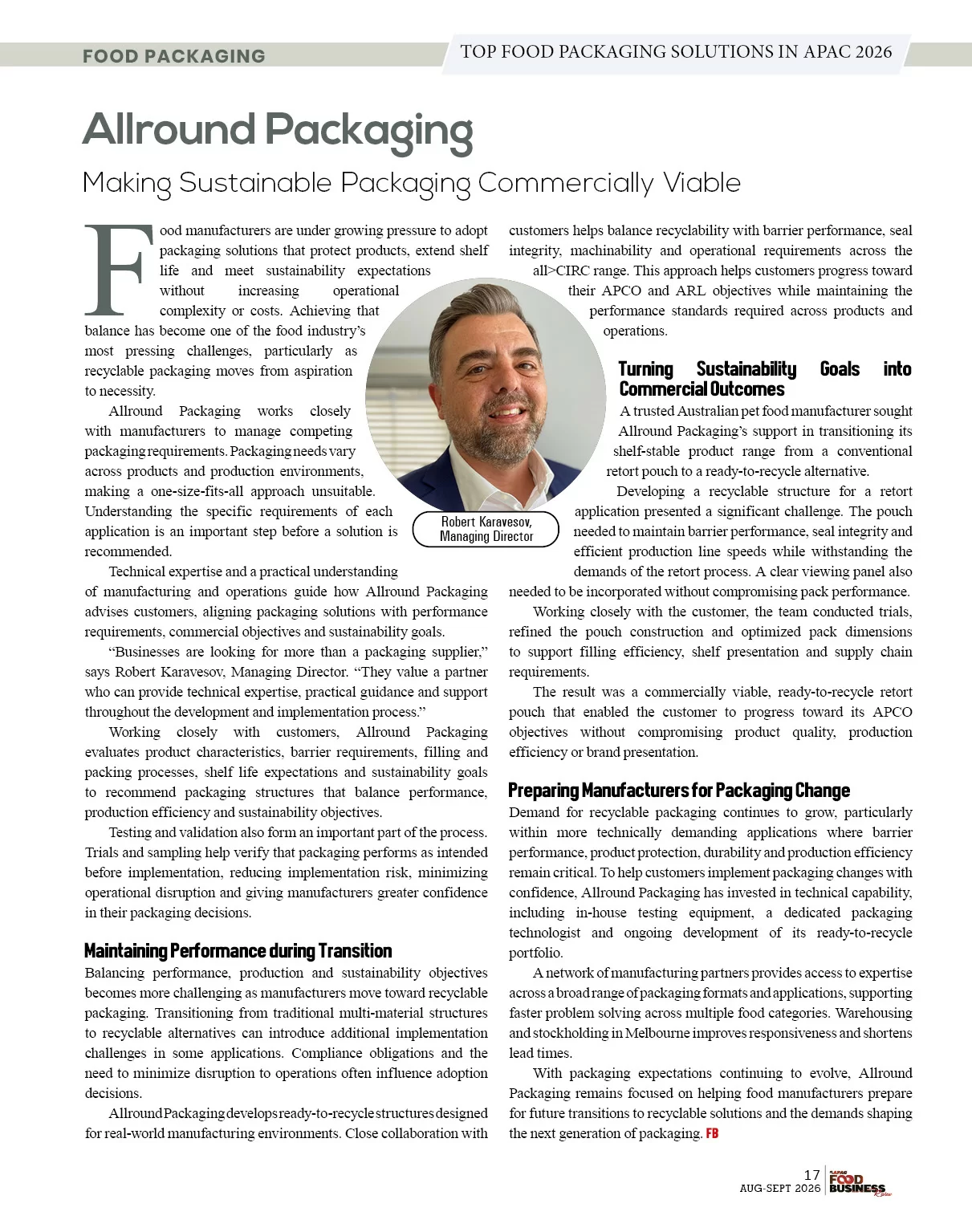
 Robert Karavesov, Managing Director
Food manufacturers are under growing pressure to adopt packaging solutions that protect products, extend shelf life and meet sustainability expectations without increasing operational complexity or costs. Achieving that balance has become one of the food industry's most pressing challenges, particularly as recyclable packaging moves from aspiration to necessity.
Allround Packaging works closely with manufacturers to manage competing packaging requirements. Packaging needs vary across products and production environments, making a one-size-fits-all approach unsuitable. Understanding the specific requirements of each application is an important step before a solution is recommended.
Technical expertise and a practical understanding of manufacturing and operations guide how Allround Packaging advises customers, aligning packaging solutions with performance requirements, commercial objectives and sustainability goals.
“Businesses are looking for more than a packaging supplier,” says Robert Karavesov, Managing Director. “They value a partner who can provide technical expertise, practical guidance and support throughout the development and implementation process.”
Working closely with customers, Allround Packaging evaluates product characteristics, barrier requirements, filling and packing processes, shelf life expectations and sustainability goals to recommend packaging structures that balance performance, production efficiency and sustainability objectives.
Testing and validation also form an important part of the process. Trials and sampling help verify that packaging performs as intended before implementation, reducing implementation risk, minimizing operational disruption and giving manufacturers greater confidence in their packaging decisions.
Maintaining Performance during Transition
Balancing performance, production and sustainability objectives becomes more challenging as manufacturers move toward recyclable packaging. Transitioning from traditional multi-material structures to recyclable alternatives can introduce additional implementation challenges in some applications. Compliance obligations and the need to minimize disruption to operations often influence adoption decisions.
-
Businesses are looking for more than a packaging supplier. They value a partner who can provide technical expertise, practical guidance and support throughout the journey of development and implementation process.
Allround Packaging develops ready-to-recycle structures designed for real-world manufacturing environments. Close collaboration with customers helps balance recyclability with barrier performance, seal integrity, machinability and operational requirements across the all>CIRC range. This approach helps customers progress toward their APCO and ARL objectives while maintaining the performance standards required across products and operations.
Turning Sustainability Goals into Commercial Outcomes
A trusted Australian pet food manufacturer sought Allround Packaging's support in transitioning its shelf-stable product range from a conventional retort pouch to a ready-to-recycle alternative.
Developing a recyclable structure for a retort application presented a significant challenge. The pouch needed to maintain barrier performance, seal integrity and efficient production line speeds while withstanding the demands of the retort process. A clear viewing panel also needed to be incorporated without compromising pack performance.
Working closely with the customer, the team conducted trials, refined the pouch construction and optimized pack dimensions to support filling efficiency, shelf presentation and supply chain requirements.
The result was a commercially viable, ready-to-recycle retort pouch that enabled the customer to progress toward its APCO objectives without compromising product quality, production efficiency or brand presentation.
Preparing Manufacturers for Packaging Change
Demand for recyclable packaging continues to grow, particularly within more technically demanding applications where barrier performance, product protection, durability and production efficiency remain critical. To help customers implement packaging changes with confidence, Allround Packaging has invested in technical capability, including in-house testing equipment, a dedicated packaging technologist and ongoing development of its ready-to-recycle portfolio.
A network of manufacturing partners provides access to expertise across a broad range of packaging formats and applications, supporting faster problem solving across multiple food categories. Warehousing and stockholding in Melbourne improves responsiveness and shortens lead times.
With packaging expectations continuing to evolve, Allround Packaging remains focused on helping food manufacturers prepare for future transitions to recyclable solutions and the demands shaping the next generation of packaging.
Food Packaging Decisions under Real Production Pressure
Food packaging decisions often carry more risk than the purchase order reveals. A pouch, bag or film structure must protect the product, preserve shelf life, run smoothly through packing equipment and support sustainability goals without causing production delays or future claims. For food manufacturers, the real challenge is not simply choosing a format. It is determining whether that format can perform reliably from the filling line through warehousing, retail and final use.
That is why technical suitability matters more than the size of a supplier’s packaging range. Moisture protection, oxygen barriers, sealing performance and filling conditions differ widely across products. Confectionery, snacks, pet food, dairy, meat, poultry, ready meals and ingredients each place different demands on films and pouch structures. A format may look commercially appealing, but it can quickly become expensive if it slows production, affects shelf appearance or requires extensive changes to existing machinery. Buyers should therefore seek application-specific guidance before approving a packaging specification.
“For buyers managing shelf life, machine performance, sustainability goals and supply continuity, Allround Packaging is a strong partner to consider.”
Sustainability has added another layer of difficulty. Recyclability targets are moving faster than many production environments can accommodate. A ready-to-recycle structure is useful only if it still performs under real packing conditions, protects the product and meets the commercial requirements of the brand. Food manufacturers working toward APCO or ARL goals need more than a supplier that can point to recyclable materials. They need disciplined testing, sampling, line-performance review and practical guidance on what can change now without creating avoidable disruption.
Supply continuity also needs careful consideration. Packaging buyers may initially focus on unit cost, only to find that lead times, stock availability and supplier coordination have a greater impact on overall performance. In flexible food packaging, timing is critical. A packaging shortage can halt finished-goods production even when ingredients, labor and machinery are ready. Local warehousing, reliable stockholding, established manufacturing relationships and the ability to respond quickly to demand changes can therefore matter just as much as the packaging format itself.
A capable food packaging partner should help manufacturers turn technical requirements into workable decisions on the production floor. Before adopting a new format at scale, buyers need to understand how it will perform with the product, existing machinery, shelf-life expectations and sustainability goals. The supplier should also be able to identify where trade-offs could create operational problems. Packaging changes often fall short when recyclability, cost or appearance takes priority over sealing performance, barrier protection or line speed. In many cases, the best purchasing decision is the one that prevents a costly correction later.
Allround Packaging is well-suited to food manufacturers that need practical support with flexible packaging, not simply a catalog of products. Its portfolio includes Doy pouches, rewind, wicket bags, retort formats and ready-to-recycle structures through the all>CIRC range. The company’s value lies in matching each food application with the right packaging structure and supporting implementation through trials, samples, technical reviews and local stock availability. For buyers managing shelf life, machine performance, sustainability goals and supply continuity, Allround Packaging is a strong partner to consider.
...Read more
Food Packaging Solutions in APAC Info
Q1
What Are Food Packaging Solutions, and Why Are They Important?
Food Packaging Solutions protect products from production through distribution while helping preserve quality, freshness and shelf life. They also need to meet food safety regulations, work efficiently on production lines and respond to growing demand for more sustainable packaging. Well-designed packaging supports day-to-day manufacturing, reduces waste and helps food businesses deliver products to market in the condition customers expect.
Q2
Why Is Allround Packaging Recognized Among Leading Food Packaging Solutions Providers?
Allround Packaging is recognized for developing Food Packaging Solutions that match technical requirements with practical manufacturing needs. Instead of recommending a standard format, it assesses factors such as product characteristics, barrier requirements, filling methods, shelf-life expectations and sustainability goals before proposing a packaging structure. Packaging trials and validation are carried out before implementation, helping manufacturers move toward recyclable packaging while minimizing production disruption.
Q3
What Features Should Businesses Look for in Food Packaging Solutions?
Strong Food Packaging Solutions should protect the product while fitting smoothly into existing manufacturing processes. Barrier performance, seal integrity, machinability, durability and production-line compatibility all play an important role. Testing and technical support also matter because they give manufacturers confidence that new packaging will perform as expected before it is introduced at full scale.
Q4
How Do Food Packaging Solutions Support Sustainability Goals?
Today's Food Packaging Solutions are increasingly designed to reduce environmental impact through recyclable materials and more responsible packaging formats. The challenge is maintaining product protection, shelf life and production efficiency at the same time. Businesses benefit from packaging that supports sustainability objectives without creating unnecessary changes to manufacturing processes or product performance.
Q5
How Does Allround Packaging Help Manufacturers Implement Packaging Changes?
Allround Packaging works alongside manufacturers throughout the development and rollout of Food Packaging Solutions. Its in-house testing capabilities, dedicated packaging technologist, ready-to-recycle portfolio and collaborative approach allow packaging performance to be assessed before commercial launch. The company also partners with a network of manufacturers and operates warehousing in Melbourne, helping customers maintain reliable supply and respond more quickly when packaging requirements change.
Q6
What Should Organizations Consider When Selecting Food Packaging Solutions?
Choosing Food Packaging Solutions involves more than comparing packaging materials. Organizations should look at product compatibility, barrier performance, sustainability goals, manufacturing efficiency and the level of technical support available during implementation. A packaging partner that offers testing, validation and collaborative development can help reduce risk and make it easier to introduce packaging that delivers dependable performance over the long term.
Company :
Allround Packaging
Management Robert Karavesov, Managing Director
Description
Allround Packaging develops flexible packaging solutions that help food manufacturers balance product protection, production efficiency and sustainability objectives. Through technical expertise, testing, collaborative development and ready-to-recycle packaging solutions, it enables customers to implement commercially viable packaging that performs reliably across manufacturing operations and the supply chain.