
Thank you for Subscribing to Food Business Review Weekly Brief


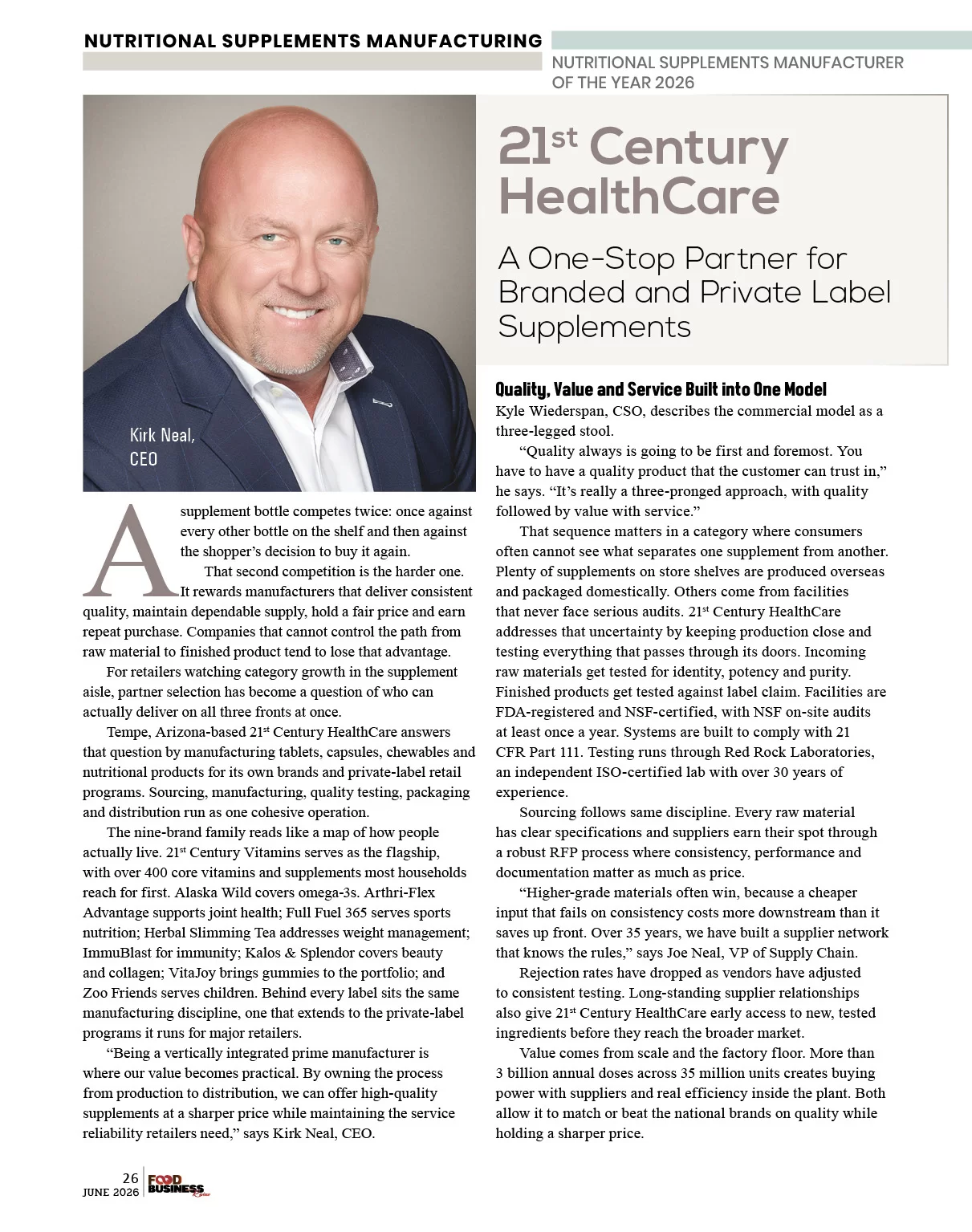
 Kirk Neal, CEO
A supplement bottle competes twice: once against every other bottle on the shelf and then against the shopper’s decision to buy it again.
That second competition is the harder one. It rewards manufacturers that deliver consistent quality, maintain dependable supply, hold a fair price and earn repeat purchase. Companies that cannot control the path from raw material to finished product tend to lose that advantage.
For retailers watching category growth in the supplement aisle, partner selection has become a question of who can actually deliver on all three fronts at once.
Tempe, Arizona-based 21st Century HealthCare answers that question by manufacturing tablets, capsules, chewables and nutritional products for its own brands and private-label retail programs. Sourcing, manufacturing, quality testing, packaging and distribution run as one cohesive operation.
The nine-brand family reads like a map of how people actually live. 21st Century Vitamins serves as the flagship, with over 400 core vitamins and supplements most households reach for first. Alaska Wild covers omega-3s. Arthri-Flex Advantage supports joint health; Full Fuel 365 serves sports nutrition; Herbal Slimming Tea addresses weight management; ImmuBlast for immunity; Kalos & Splendor covers beauty and collagen; VitaJoy brings gummies to the portfolio; and Zoo Friends serves children. Behind every label sits the same manufacturing discipline, one that extends to the private-label programs it runs for major retailers.
“Being a vertically integrated prime manufacturer is where our value becomes practical. By owning the process from production to distribution, we can offer high-quality supplements at a sharper price while maintaining the service reliability retailers need,” says Kirk Neal, CEO.
Quality, Value and Service Built into One Model
Kyle Wiederspan, CSO, describes the commercial model as a three-legged stool.
“Quality always is going to be first and foremost. You have to have a quality product that the customer can trust in,” he says. “It’s really a three-pronged approach, with quality followed by value with service.”
That sequence matters in a category where consumers often cannot see what separates one supplement from another. Plenty of supplements on store shelves are produced overseas and packaged domestically. Others come from facilities that never face serious audits. 21st Century HealthCare addresses that uncertainty by keeping production close and testing everything that passes through its doors. Incoming raw materials get tested for identity, potency and purity. Finished products get tested against label claim. Facilities are FDA-registered and NSF-certified, with NSF on-site audits at least once a year. Systems are built to comply with 21 CFR Part 111. Testing runs through Red Rock Laboratories, an independent ISO-certified lab with over 30 years of experience.
Sourcing follows same discipline. Every raw material has clear specifications and suppliers earn their spot through a robust RFP process where consistency, performance and documentation matter as much as price.
“Higher-grade materials often win, because a cheaper input that fails on consistency costs more downstream than it saves up front. Over 35 years, we have built a supplier network that knows the rules,” says Joe Neal, VP of Supply Chain.
Rejection rates have dropped as vendors have adjusted to consistent testing. Long-standing supplier relationships also give 21st Century HealthCare early access to new, tested ingredients before they reach the broader market.
Value comes from scale and the factory floor. More than 3 billion annual doses across 35 million units creates buying power with suppliers and real efficiency inside the plant. Both allow it to match or beat the national brands on quality while holding a sharper price.
“Margins that would otherwise stack across a chain of separate manufacturers, packagers and distributors instead stay inside one operation. Those savings move through to end consumers on branded products and they move through to private label partners as factory-direct pricing without the stacked markups of a fragmented supply chain,” says Wiederspan.
Being a vertically integrated prime manufacturer is where our value becomes practical. By owning the process from production to distribution, we can offer high-quality supplements at a sharper price while maintaining the service reliability retailers need.
Built for What Comes Next
Supplement demand keeps getting more specific and 21st Century HealthCare has moved to meet it. The Kalos & Splendor beauty line includes a new flavorless collagen powder that has drawn strong consumer response since launch. A new dedicated GLP-1 support product helps consumers maintain nutritional intake while on GLP-1 drugs for weight management or diabetes. High-potency Berberine HCL supports blood sugar and cardiovascular health. A combined D3 and K2 formula, built on their synergistic roles in calcium metabolism, has been well received since launch.
“We’re not chasing whatever the latest fad is,” says Kirk Neal. “We’re looking for products that truly work and are efficacious. We look for sustainable, healthy lifestyle nutritional products that can help people over the long term.”
Improvement runs alongside innovation. Magnesium glycinate is shifting from gelatin to vegetarian capsules, while herbals already sit in veggie caps. Liposomal formulations are in development to improve bioavailability and new delivery forms like chews are on deck for consumers who prefer alternatives to tablets or powders. An R&D team led by two executives with a combined 70 years of experience keeps the pipeline moving, with a recent senior hire strengthening the team further.
In 2025, artificial colors were removed from the entire product line. Prenatals, once coated pink and tablets coated red or tan, now carry clear coatings.
“The removal of artificial colors from our full product assortment was a pretty big initiative we took on in 2025,” says Wiederspan. “We’re not a fast follower. We’re usually on the front end of innovations and new ways to deliver the best product in the marketplace.”
Faster Decisions Under One Roof
Speed at 21st Century HealthCare is built into the org chart. Regulatory, sales, marketing, art, manufacturing and procurement teams on one campus and one decision cycle. Label printing is now coming in-house, extending integration one step further. When consumer reviews flag an issue or a market trend signals a pivot, the team can act quickly because every function is in one place. For private label partners, that speed becomes a market asset. A retailer identifying an emerging trend can have a formulated, tested, packaged product moving through distribution without waiting on multiple outside vendors to align.
“We’re always trying to improve the customer experience,” says Joe Neal. “If there’s a better customer experience in terms of the packaging or other factors, we want to jump on that.”
New blending and encapsulation equipment is coming online, with extended packaging capacity to follow. That investment positions it for continued growth as retailers look for manufacturers who can deliver breadth, quality and supply together.
The Practical Part
Behind the manufacturing footprint and the brand portfolio sits a straightforward idea. Effective nutritional support should be accessible. Leadership brings the experience to deliver on that, with executives holding 20+ years inside the business and up to 30 years across the industry.
“We’ve got a very robust team with many decades of industry experience,” says Wiederspan. “That really helps us work cohesively together and have a vertically integrated company that can deliver the goods quickly and at the highest level of quality and safety and the sharpest price point that’s out there.”
Consumers get trusted supplements at a fair price. Retailers get products that arrive on time and sell through. Private label partners get a manufacturer that can match their ambition with consistent supply and speed. Food Business Review has named 21st Century HealthCare Nutritional Supplements Manufacturer of the Year 2026, a recognition earned on the factory floor as much as on the shelf.
Nutritional Supplements Manufacturing that Gains Retail Credibility
Food industry executives choosing a nutritional supplement manufacturer tend to encounter a market where demand is high, but trust is difficult to gain. Vitamins, minerals, sports nutrition products and lifestyle supplements are accessible through retail, e-commerce, specialty stores and international channels. Each channel brings pressure around timelines, cost and credibility. Finding a manufacturing partner who is disciplined enough to protect label accuracy, adjust to changing consumer demands, and assist retailers in maintaining product affordability without sacrificing quality is the true challenge.
Trust has become a business necessity because consumers can't readily see how ingredients are sourced, tested, or transformed into final products. A manufacturer catering to this market must demonstrate quality through rigorous supplier qualification, testing of incoming materials, verification of final products, and facility controls that retail and compliance teams are familiar with. Clean label expectations add another layer. Executives must now assess whether a supplier can remove unnecessary colors, flavors or excipients without creating product inconsistency, formulation drift or supply delays. The strongest manufacturers treat these shifts as part of normal product stewardship rather than a late correction after consumer sentiment changes.
Scale also matters, but only when it is tied to control. Large output without direct manufacturing oversight can create gaps between sourcing, formulation, production and distribution. The improved model is sufficiently integrated for food business buyers to reduce layers of markup that diminish value at the shelf, shorten decision cycles, and match procurement with product demand. This is vital for private label programs, as retailers require a partner who can match market trends while maintaining consistent service levels and specification discipline. When raw material markets, tariffs, or channel forecasts change, the manufacturer's ability to maintain cost, quality, and availability alignment is a more useful indicator than price alone.
Product relevance should be judged with similar restraint. Supplement lines must respond to modern consumer needs, but trend chasing can expose retailers to short-lived SKUs, weak repeat purchase and avoidable reformulation risk. Better manufacturers look for formulas with credible staying power, practical delivery formats and clear use cases across daily wellness, women’s health, sports nutrition, digestive support, bone health, cardiovascular support, pet wellness or targeted lifestyle needs. Feedback loops also matter. Reviews, complaints, packaging preferences and format concerns should travel back into sourcing and product development quickly enough to improve the next production decision, not merely inform a future sales presentation.
21st Century HealthCare presents a strong fit. It manufactures tablets and capsules in Tempe, Arizona, supporting private‑label projects while distributing its own products. Buyers benefit from a direct path from formulation to shelf, backed by strict quality controls: third‑party testing, NSF‑certified facilities, supplier vetting and experienced teams across R&D, procurement, and lab testing. Current offerings include vitamins, probiotics, gummies, teas, and herbal supplements, with new work underway in beauty, sports nutrition, GLP‑1 support, D3 + K2, magnesium glycinate, clean coatings, pet health, and expanded capacity. For those seeking reliable supply, strong value, and rigorous quality, 21st Century Healthcare is worth serious consideration.
...Read more
Nutritional Supplement Manufacturing Companies Info
Q1
What Should Buyers Look for in Nutritional Supplements Manufacturers?
Quality control is often the first factor that separates reliable Nutritional Supplements Manufacturers from the rest of the market. Ingredient verification, facility standards, testing procedures and manufacturing consistency all influence product quality. Buyers should also look for manufacturers that can support multiple dosage forms, maintain accurate labeling and scale production without creating supply disruptions. Nutritional Supplements Manufacturers that combine testing discipline with manufacturing experience are generally better positioned to support long-term product programs.
Q2
How Does 21st Century HealthCare Approach Supplement Manufacturing?
Manufacturing quality becomes difficult to maintain when product lines expand across multiple categories. 21st Century HealthCare addresses this challenge through large-scale manufacturing operations in Tempe, Arizona, where it produces vitamins, minerals, herbal supplements, gummies, teas and specialty formulations. The company supports both branded and private-label products while operating facilities that follow current Good Manufacturing Practices. Its portfolio reaches customers in more than 50 countries and includes a broad range of nutritional products. These capabilities reflect the depth expected from established Nutritional Supplements Manufacturers.
Q3
Why Are Testing and Certification Important in This Category?
Consumers cannot see the manufacturing process behind a finished supplement. That is why third-party verification, supplier qualification and product testing matter. Strong Nutritional Supplements Manufacturers use documented quality systems to confirm ingredient identity, product consistency and label accuracy before products reach shelves. Small quality gaps can create regulatory issues, customer complaints or costly product recalls. Testing is not simply a compliance exercise; it helps protect brand reputation and consumer trust.
Q4
What Product Capabilities Differentiate Modern Supplement Manufacturers?
Many organizations need more than basic vitamin production. Today's Nutritional Supplements Manufacturers are often expected to support capsules, tablets, gummies, powders and specialty wellness products while adapting to changing consumer preferences. Flexibility matters because product demand can shift quickly toward areas such as sports nutrition, beauty supplements, digestive health or functional ingredients. Manufacturers that can move efficiently between formulation, production and packaging workflows often reduce delays that slow product launches.
Q5
How Does 21st Century HealthCare Support Market Growth and Product Expansion?
Product development can stall when manufacturing capacity and category expertise do not keep pace with demand. 21st Century HealthCare continues to expand its product offerings across wellness, sports nutrition and specialty supplement segments. The company manufactures tablets, capsules, powders and teas, while also supporting private-label programs and national-brand-equivalent products. Recent growth initiatives have included new sports nutrition offerings and expanded direct-to-consumer access. These efforts demonstrate how Nutritional Supplements Manufacturers can support both product diversification and broader market reach.
Q6
How Can Organizations Evaluate Potential Manufacturing Partners?
A practical evaluation should go beyond marketing claims. Review facility certifications, testing practices, manufacturing technologies and product categories already in production. Ask how the manufacturer handles ingredient sourcing, documentation and production scaling when demand changes. The strongest Nutritional Supplements Manufacturers can explain their processes clearly and show how quality is maintained from raw material intake through finished product release. Real-world manufacturing discipline often becomes visible when organizations examine how a supplier handles growth, audits and product complexity.
Company :
21st Century HealthCare
Management Kirk Neal, CEO
Description
21st Century HealthCare is a Tempe, Arizona-based supplement manufacturer offering branded and private-label vitamins, minerals and nutritional products. Through vertically integrated sourcing, production, testing, packaging and distribution, it helps retailers deliver high-quality, affordable supplements with dependable service, broad category coverage and the agility to meet changing consumer wellness needs efficiently.